



Outlook
How Midwest Cropland Earns Its Return
The Rural Economist: Spring 2026, Part 1

Report Snapshot
Situation
Despite weaker crop prices, demand for cropland remains resilient. As producers and investors reassess their portfolios post-pandemic, a central question emerges: Over the long run, how do differences in income support, appreciation and volatility shape inflation-adjusted cropland returns across the Midwest and Plains?
Finding
In a higher-for-longer rate environment, markets that rely more heavily on appreciation are likely to feel greater pressure as capitalization assumptions adjust and buyer affordability tightens. Income-oriented markets such as Kansas and South Dakota are better positioned to absorb higher borrowing costs because ongoing carry offsets some valuation risk.
Income, Appreciation and Cycle Risk
Over the past few years, the Midwest agricultural economy has transitioned from a period of rapid post-pandemic appreciation to a more moderate growth pattern for cropland values. Despite weaker crop prices, demand for cropland remains resilient, supported by scarce, high-quality acreage; persistent global food demand; renewable energy investment; commercial development; and cropland’s notable role as a long-term hedge to inflation.
As producers and investors reassess their portfolios now that the pandemic’s effects have faded, a central question emerges: Over the long run, how do differences in income support, appreciation and volatility shape inflation-adjusted cropland returns across the Midwest and Plains?
My research finds three observations of the economics of cropland across the Midwest and Plains:
- Cropland returns follow the agricultural cycle, with income moving first and land values adjusting later.
- Markets with stronger real income support tend to navigate down-cycles and tighter credit more smoothly, while appreciation-dependent regions face greater sensitivity when margins weaken.
- Volatility reflects exposure to agricultural cycles, not just average returns.
Current Returns to U.S. Cropland
From an economic standpoint, cropland investors receive two sources that equate to their return on investment: 1) the net cash return and 2) the price appreciation measured in real terms.
Current returns to agricultural cropland in 2025 vary widely across the country but generally fall between 1.9% and 3.3% across the Midwest, reflecting strong underlying land values and moderating cash rents. These returns remain below alternative safe-asset benchmarks, including a 4.3% 10-year Treasury, suggesting cropland continues to be priced at a premium relative to its current income yield.
For producers, these return levels signal a market still supported by long-term confidence in cropland as an investment but also constrained by weaker commodity price trends and cautious rent growth. Many operators continue to face compressed margins, and rental negotiations have leaned toward stability rather than sharp increases, particularly in the corn belt. Looking ahead to 2027, if crop prices remain under pressure, rents may adjust slowly downward, providing some cost relief for tenants.
From 1990 to 2025, cropland delivered strong nominal performance across much of the Midwest and Plains.
Additionally, if interest rates ease, farmland values may stabilize or strengthen, which would support balance sheets. Overall, the 2027 outlook points to steady but subdued cropland returns, with profitability hinging more on operational efficiency and market conditions than on significant appreciation in land income.
Long-Term Returns on Investment: Midwest and Plains Cropland
From 1990 to 2025, cropland delivered strong nominal performance across much of the Midwest and Plains, with average annual total returns ranging from about 9% to 17% by state. South Dakota led with an average nominal total return of 17.3%, followed by Kansas at 14.6% and Nebraska at 13.4%. Eastern corn belt states Indiana (9.7%), Ohio (9.6%) and Illinois (9.5%) clustered at the lower end of the range.
Real total returns compress meaningfully, falling into a tighter range of approximately 4% to 12%. The highest real returns were still led by South Dakota (11.6%) and Kansas (9%), with Iowa (5.4%), Indiana and Ohio (near 4.2%), and Illinois (4%) trailing behind.
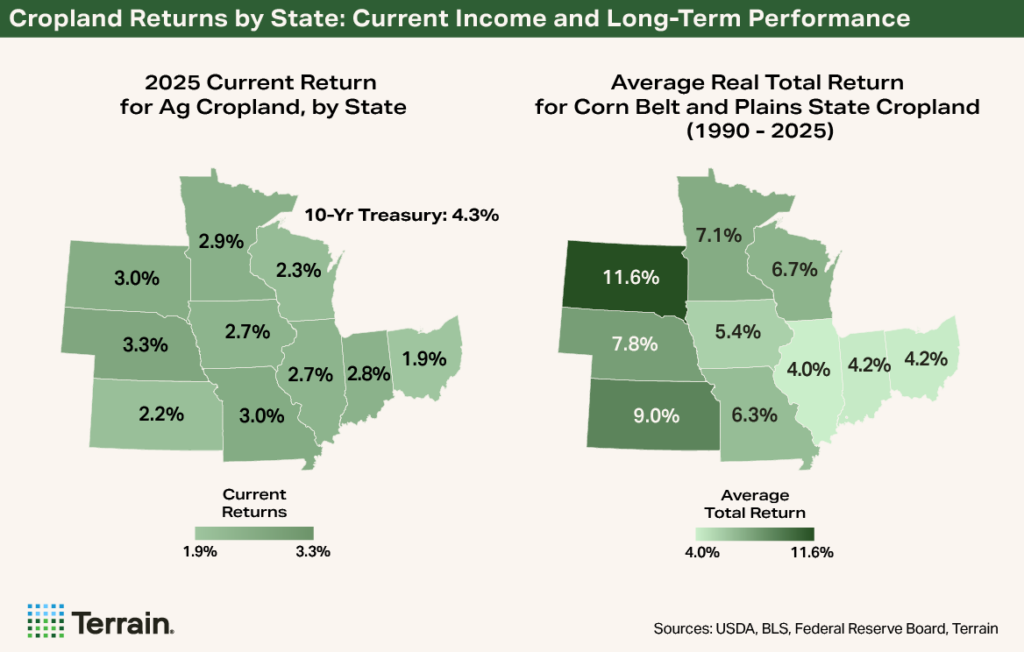
The consistent gap between nominal and real performance — approximately 5.5 percentage points per year — underscores that a substantial portion of long-run nominal land returns reflected inflation flowing through rents, revenue expectations and land values rather than outright real wealth creation.
Return Composition Matters
The return composition further clarifies why land markets behave so differently across regions.
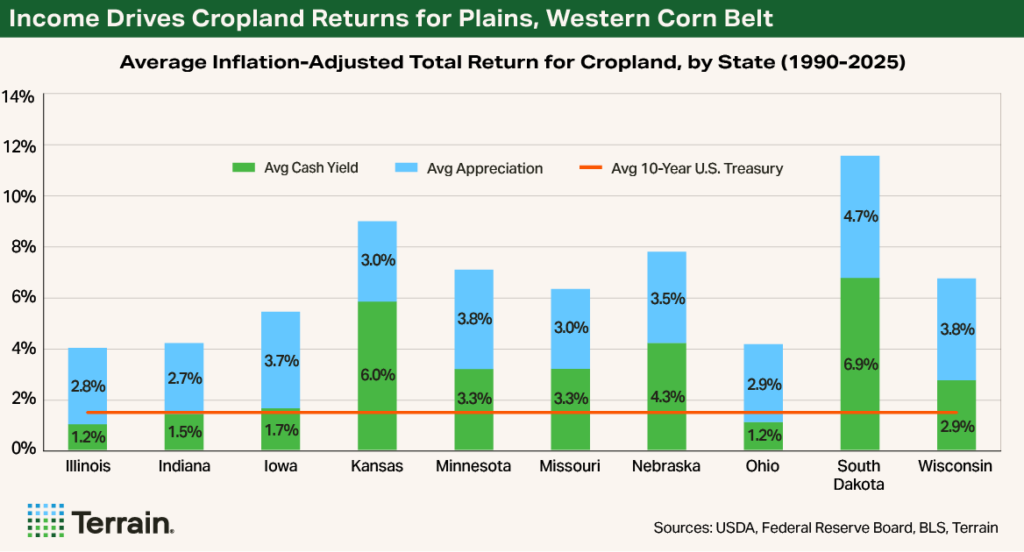
The Plains and western corn belt feature a return profile that is more income-driven even after inflation, with wider distributions, reflecting variability that shows up primarily through operating results versus sharp value swings. From 1990-2025, South Dakota generated a real cash yield of 6.9%, accounting for nearly 60% of its 11.6% real total return, while Kansas posted a 6% real cash yield, supporting a 9% real total return.
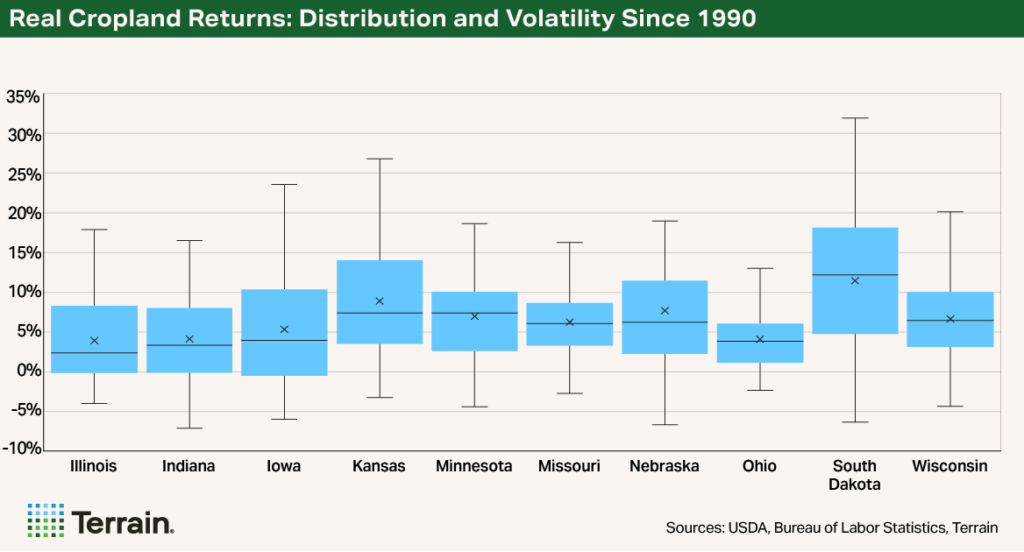
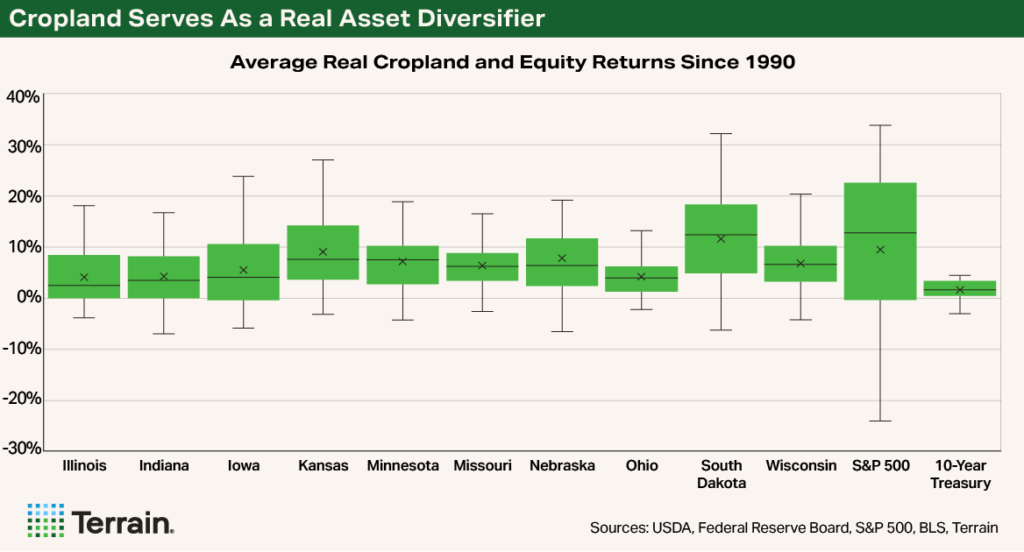
In the box and whisker chart showing the distribution and volatility of cropland returns, these states exhibit higher medians and broader ranges. This is consistent with markets where strong carry supports returns over the long run but introduces greater year-to-year dispersion tied to income and production conditions. Nebraska shares several of these characteristics, with a 4.3% real cash yield and 7.8% real total return, though its wider whiskers and larger spread underscore materially higher variability.
By contrast, eastern corn belt states show tighter distributions around lower medians, reflecting substantial compression in real cash yields, often averaging 1% to 2%, leaving performance more dependent on appreciation.
Volatility reinforces the structural differences between states and helps explain why cropland outcomes can feel different depending on location.
Illinois, for example, generated a 1.2% real cash yield, with 2.8% real appreciation accounting for most of its 4% real total return. Meanwhile, Iowa’s 5.4% real return was driven largely by 3.7% real appreciation. These markets function more like longer-duration assets, where outcomes are increasingly sensitive to valuation assumptions, buyer liquidity and interest rate dynamics.
Missouri, in particular, paired a 6.3% real total return with comparatively low variability, making it one of the most stable long-run investments in the group.
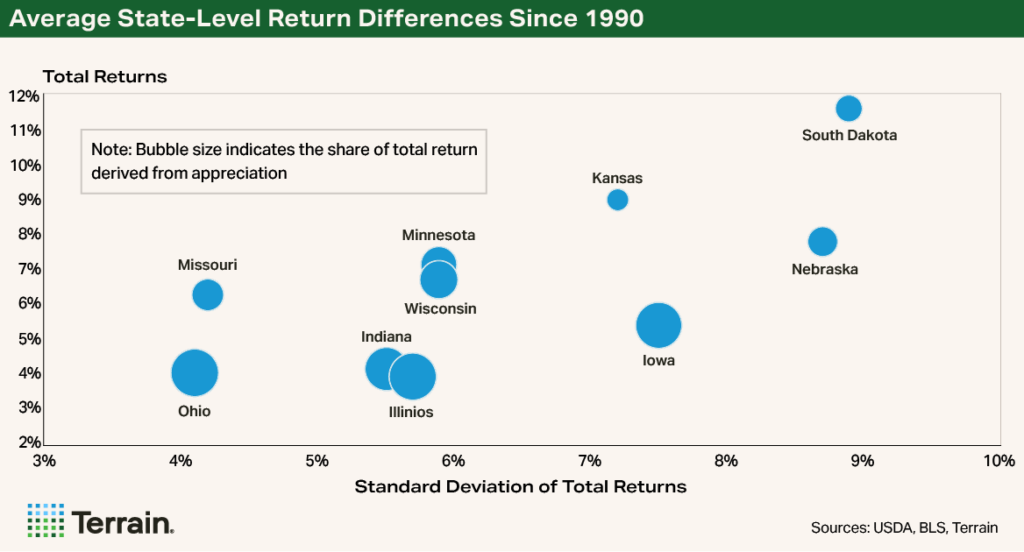
Volatility reinforces the structural differences between states and helps explain why cropland outcomes can feel different depending on location. States such as South Dakota (8.9% real volatility), Nebraska (8.7%), Iowa (7.5%) and Kansas (7.2%) show wider boxes and long whiskers, reflecting greater exposure to production variability, income swings and land price cycles.
Nebraska illustrates this tradeoff clearly: While real returns averaged 7.8% over the time series, outcomes varied widely from year to year, increasing sensitivity to timing and leverage. In contrast, Missouri (4.2% real volatility) and Ohio (4.1%) display tighter distributions with fewer extreme outcomes. Missouri, in particular, paired a 6.3% real total return with comparatively low variability, making it one of the most stable long-run investments in the group.
From a market perspective, appreciation-heavy regions tend to experience more intermittent price discovery, particularly around rate inflection points. Income-oriented markets tend to work through good and bad years by adjusting rents and cash flow, rather than experiencing sudden, sharp swings in land prices when conditions change.
For producers and investors, the box and whisker chart makes clear that land decisions are not about chasing the highest average return but understanding how a market can behave over the long run and even during weaker years.
The chart shows that some states have higher typical returns but much wider ranges and deeper downside tails, meaning returns can swing sharply when margins tighten or interest rates rise. Other states show tighter groupings and shallower downside, indicating more consistent performance and fewer extreme outcomes when conditions change.
Return structure and downside behavior over the long run are what ultimately determine resilience when conditions tighten.
This difference matters because it determines how forgiving a market is at purchase: Wider downside ranges often require more equity and balance sheet capacity to absorb volatility, while steadier markets tend to be easier to hold through over the long run even if they don’t lead during peak years.
In that sense, the chart highlights why headline averages alone (for example, what the piece of cropland returned on paper) can be misleading. Return structure and downside behavior over the long run are what ultimately determine resilience when conditions tighten.
(Note: For this analysis, cash returns were calculated as the annual net operating income generated by cropland expressed as a percentage of land value and adjusted for inflation to reflect real purchasing power. Each state’s average revenue was determined by a corn and soybean mix, while wheat was included in this mix for Kansas. Appreciation returns were calculated as the year-over-year change in cropland values, also adjusted for inflation, capturing real gains or losses in land prices over time.)
Portfolio Performance: Cropland vs. Traditional Financial Assets
Placing cropland alongside traditional financial assets further highlights its role in investment portfolios.
Cropland consistently exceeded Treasuries on a real return basis while exhibiting volatility far closer to fixed income than equities.
Over the same period (1990-2025), the S&P 500 delivered an average 12.3% nominal total return and 9.4% real total return, driven primarily by price appreciation (10% nominal, 7.2% real) but with significantly higher volatility. Equity total return variability averaged 17.3%, more than double that observed in most cropland markets, underscoring the broader dispersion and drawdown risk associated with public equities.
At the opposite end of the spectrum, the 10-year U.S. Treasury produced an average 4.3% nominal yield and 1.5% real yield, with yield volatility near 2%, offering stability but limited real wealth creation over time. Against these benchmarks, cropland consistently exceeded Treasuries on a real return basis while exhibiting volatility far closer to fixed income than equities, reinforcing its position as a real asset diversifier rather than a direct equity substitute.
State-Level Real Cropland Performance: Risk, Reward and Cycle Exposure
Across the Midwest and Plains, returns vary meaningfully based on the balance between income carry and land appreciation, with important implications for volatility, interest rate sensitivity and purchasing discipline.
Illinois, Indiana and Ohio
Illinois, Indiana and Ohio represent valuation-led markets with modest real total returns (4%-4.2%) driven primarily by appreciation rather than income. Real cash yields range from just 1.2% to 1.5%, leaving outcomes highly sensitive to entry pricing, discount rates and buyer affordability. Volatility is moderate (4%-6%), but thin carry provides limited downside cushion during periods of margin compression or elevated borrowing costs.
These states tend to perform best during agricultural margin upcycles when optimism and liquidity accelerate land values, but they are more exposed to repricing risk when financing tightens.
Iowa
Iowa delivers stronger performance (5.4% real total return), led by robust appreciation (3.7%) and supported by modest income (1.7%). However, volatility is elevated (7.5%), reflecting pronounced exposure to land price cycles. Iowa functions as a high-quality but timing-sensitive market: Returns can accelerate meaningfully in agricultural margin upcycles but can also retrace sharply when margins weaken or interest rates rise, making leverage and entry discipline critical.
Minnesota and Missouri
Minnesota and Missouri occupy the most balanced and risk-efficient segment of the spectrum. Minnesota generated a 7.1% real total return, split almost evenly between income (3.3%) and appreciation (3.8%), with moderate volatility (5.9%). Missouri delivered a 6.3% real return with one of the lowest volatility readings (4.2%), supported by a similar balance between yield and appreciation.
These states provide durable compounding across cycles and function as portfolio stabilizers, particularly valuable for lenders and diversified investors seeking steadier collateral behavior.
Wisconsin
Wisconsin exhibits a moderately appreciation-tilted but still-balanced profile, producing a 6.7% real total return with mid-level volatility (5.4%). Returns are resilient across most cycles, though somewhat more exposed to tighter credit conditions than income-forward states.
Nebraska
Nebraska offers strong long-run performance (7.8% real total return), supported by solid carry (4.3%) and appreciation (3.5%) but with significant variability. Volatility is among the highest (8.7%), driven largely by valuation swings. While income support improves through cycle performance, the wide dispersion requires conservative leverage, stress-testing and pricing discipline at cycle turning points.
Kansas and South Dakota stand out as income-forward return leaders.
Kansas and South Dakota
Kansas and South Dakota stand out as income-forward return leaders. Kansas produced a 9% real total return, with roughly two-thirds derived from income, enhancing resilience in higher-rate environments. South Dakota led all states with an 11.6% real total return, supported by a 6.9% real cash yield and 4.7% appreciation, though with high volatility (8.9%).
In both states, historical returns were boosted by elevated pre-2012 cash yields, underscoring the importance of recognizing structural yield shifts over time. These markets provide strong self-carry but require tolerance for operating and weather-driven income variability.
Cropland markets with durable income support tend to navigate rate transitions more smoothly than those dependent on appreciation.
Cropland Markets Will Function Differently Moving Forward
Cropland is inherently a long-duration asset, and shifts in discount rates tend to influence land values more quickly than they alter operating fundamentals. In a higher-for-longer rate environment, markets that rely more heavily on appreciation are likely to feel greater pressure as capitalization assumptions adjust and buyer affordability tightens. Income-oriented markets are better positioned to absorb higher borrowing costs because ongoing carry offsets some valuation risk.
As rates eventually stabilize or move lower, appreciation-driven markets may regain momentum, but the experience of the past cycle reinforces a key takeaway: Cropland markets with durable income support tend to navigate rate transitions more smoothly than those dependent on appreciation.
Bottom line: For farmers and investors, the balance of the primary source of returns (income versus appreciation) and volatility influences how forgiving purchase prices are under differing macro and agricultural cycles. Cropland owners, and future purchasers, should understand the influence of each cycle on the land that they own to balance risks and rewards. The current interest rate and agricultural profit cycles are likely to reward disciplined pricing, strong balance sheets, and portfolios that balance income resilience with long-term appreciation potential rather than leaning exclusively on either return engine.


Terrain content is an exclusive offering of AgCountry Farm Credit Services,
American AgCredit, Farm Credit Services of America and Frontier Farm Credit.