



Quarterly Outlook • July 20, 2026
More Bushels for Biofuels and Beijing


Report Snapshot
Situation
Total soybean stocks on June 1 rose year over year (YOY), though declines in on-farm holdings signal active farmer selling. The USDA expects increased soybean supply with the 2026/27 crop, driven by higher planted acres and trend yields, with stronger gains in eastern regions.
Finding
Demand remains a key influence, with biofuel feedstock consumption gradually ramping up and export activity — especially from China — playing a central role in recent price direction.
Outlook
Soybean prices are expected to remain rangebound, with near-term futures in the mid-$11 to low-$12 range and seasonal pressure at harvest. Market direction will depend on U.S. and South American weather, China’s purchasing pace and level, and biofuel-driven demand. For 2026/27, I forecast season-average prices between $11/bu. and $12/bu., reinforcing the need for disciplined marketing and risk management.
Acres and Stocks Shift in June Report
As expected, U.S. farmers planted more soybeans than last year and more than the USDA’s March Prospective Plantings report showed. Since the beginning of March, estimated average relative crop margins between corn and soybeans had shifted noticeably to favor soybeans. During February, this relative margin averaged nearly even between corn and soybeans. Since March, this relative margin has improved (amid volatility) to average $61/ac. in favor of soybeans.
The USDA now expects 85.365 million acres of soybeans, up from 81.215 million last year, with just over 8 million of those acres left to plant as reported by the USDA in the June 30 Acreage report. Using state trend yields, I forecast total production at 4.47 billion bushels, up 4.8% from last year.
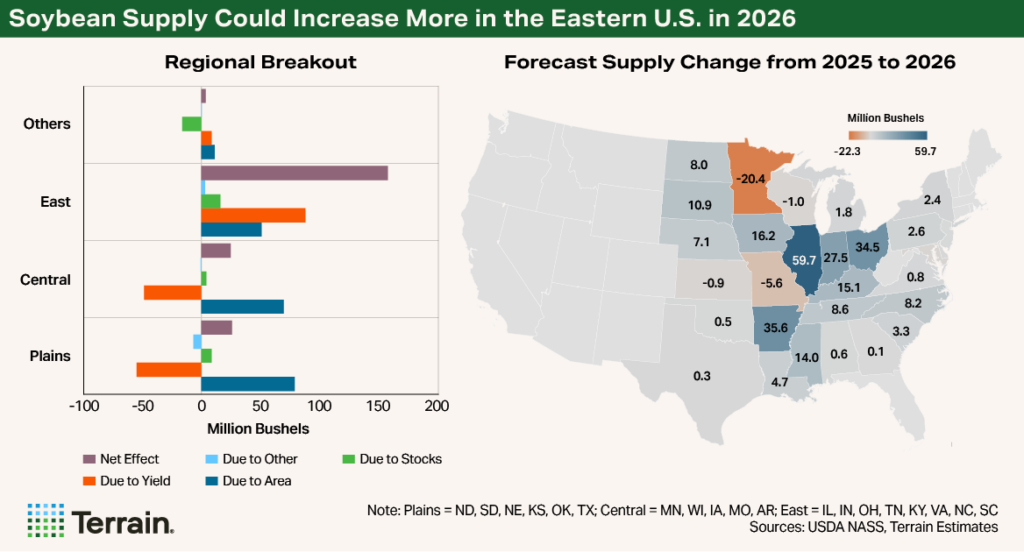
Regionally, the total supply change from 2025 to 2026 is expected to grow more in the east than in the west.
Also released on June 30 was the quarterly Grain Stocks report, which showed total soybean stocks at 1.06 billion bushels, 5% higher than a year ago. While higher overall, on-farm stocks were down from a year ago while off-farm stocks were higher, indicating significant farmer selling over the past quarter with stocks available to either crush or export in the months ahead.
Regional Rebalance Possible in 2026/27
Regionally, the total supply change from 2025 to 2026 is expected to grow more in the east than in the west. In the east, larger acres and yield are expected to drive this increase, while in the central and Plains regions, higher soybean acres are partially offset by lower yields for a smaller supply change forecast.
If these forecasts materialize, the production shifts may not significantly affect the overall market prices, but they will likely affect regional basis, and thus farm prices, as we shift to the marketing year ahead.
Biofuels to Consume More in 2026/27
Since April, the renewable fuel industry has worked to increase plant capacity utilization, biofuel production and feedstock consumption to meet the new Renewable Volume Obligations (RVOs) announced by the EPA on March 27. In the latest data for May, production was still about 9% under the pace likely needed to satisfy the annual RVO, although the gap narrowed from April. The RVOs are expected to support strong demand for biofuel feedstocks, including soybean oil, underpinning soybean crush demand and prices.
However, a couple of key indicators should be monitored in the months ahead for confirmation of continued strength or emerging weakness:
- Watch for continued increases in biofuel plant utilization rates and biomass-based diesel production, which will indicate the industry is working toward the pace needed to meet RVO obligations. At about 37%, the current share of soybean oil in total feedstock use is critical for supporting prices — particularly as competing feedstocks such as used cooking oil, tallow and canola oil can limit upside if price relationships shift.
- Look for continued strength in Renewable Identification Number (RIN) values and crush margins, as these both measure the economic incentives driving biofuel (RIN) or feedstock (crush margin) production.
Together, these indicators will determine the strength of support for soybean prices as we look toward the 2026/27 marketing year.
China Remains Key Demand Risk
Soybean prices have shifted throughout 2026 based on the changing expectation of China’s soybean purchases. China’s commitment from last fall to buy 12 million metric tons (MMT) has been fulfilled and almost entirely shipped. Attention now turns to the commitment of 25 MMT (or about 918.6 million bushels) for the 2026 crop.
If China’s purchases continue at even a semiregular pace, I expect prices to remain supported.
The first week of July saw announced purchases for fall 2026 shipment in addition to a small amount already on the books — important steps for reaching the 25 MMT target. Prices have reacted favorably to these purchases as a bit more assurance that targets will become reality as purchases are executed.
If China’s purchases continue at even a semiregular pace, I expect prices to remain supported. However, an extended period without buying is likely to be met with prices trending downward, absent other factors such as adverse weather. China’s import demand level and origin decisions are key to sustaining higher prices.
Expectations for the South American crop are another factor to watch in the months ahead.
Weather Risk for South America
Expectations for the South American crop are another factor to watch in the months ahead. Over the past 20 to 25 years, a strong El Niño, like the one currently forecast, has typically been associated with below-trend yields in Brazil and above-trend yields in Argentina. With Brazil having more soybean area than Argentina, the net impact is possibly lower South American supplies than the USDA forecasts for 2026/27.
In order for supplies from these two countries to be larger than 2025/26, Argentina needs to shift acres back toward soybeans, as expected, and Brazil must add at least 1 million hectares of soybeans for 2026/27. Anything less than this, or a more adverse impact to yields, could further diminish global soybean supplies in 2026/27 and offer support for U.S. farm prices above $12/bu.
This outcome is by no means guaranteed, so risk management will remain key to balancing price risk versus risk tolerance for your operation for the marketing year ahead.
Price Outlook
I forecast nearby soybean futures prices through August (the remainder of the 2025/26 marketing year) to remain in the $11.75/bu. to $12.25/bu. range, with fluctuations related to weather forecasts, Chinese purchases and the pace of domestic crush. Cash prices will continue to vary widely from about $11.25/bu. to $13/bu. depending on geography and local demand (elevator versus crush plant).
For the full 2026/27 marketing year, I forecast season-average soybean prices between $11/bu. and $12/bu.
Around harvest, new-crop futures prices are likely to range between $11.50/bu. and $12/bu. as we enter the typical harvest low period. Brazil’s soybean area expectations will become more certain during this time, even though yield uncertainty remains through the end of 2026.
- Harvest prices at or below the lower end of the range are expected if U.S. yields end up above trend, or South American production is larger than currently expected from area, yields or both.
- The upper end of the range is associated with below-trend U.S. yields and a South American supply forecast that is below initial expectations, alongside expanding global consumption.
For the full 2026/27 marketing year, I forecast season-average soybean prices between $11/bu. and $12/bu., largely dependent on U.S. and South American yields.
While the outlook has shifted toward higher prices than just a few months ago, having a proactive plan to capture these higher prices, and manage price risk in general, will be key for the 2026 crop.


Terrain content is an exclusive offering of AgCountry Farm Credit Services,
American AgCredit, Farm Credit Services of America and Frontier Farm Credit.