



Outlook • June 18, 2026
Connecting Farm Returns to Farmland Value in California
The Rural Economist: Spring 2026, Part 2

Report Snapshot
Situation
Groundwater rules, squeezed margins and other factors are causing extended volatility and softening in California farmland values. Purchasing land in this environment requires an approach that will tie land values to a property’s ability to generate income.
Finding
While looking to comparable sales in an area can provide a useful base of actual market activity, a discounted cash flow approach goes further by assessing the income a property can reliably generate.
California farmland value trends of volatility and softening from the past few years are persisting, although where they are happening and to what degree are slightly changing. In the Central Valley, where volatility has been most pronounced, values have continued to decline in some regions while stabilizing in others (though those values are well off their peaks). Along the coast, row crop ground, which has historically been more stable, has softened in most counties after holding up relatively well the year prior.
During a period of volatile land values, an assessment of the income a property can reliably generate is just as important.
The extended period of volatility in California land values can be attributed to a variety of forces:
- Though crop prices aren’t as low as they were in 2022, they are by no means high. This, combined with elevated input costs and interest rates, has continued to squeeze margins.
- The onset of groundwater legislation continues to play a role in this complex story, with better water areas demonstrating resilience and worse ones showing downward pressure.
Against this backdrop, producers I meet with often ask how to approach land purchases. Looking to comparable sales in an area can provide a useful base of actual market activity. However, during a period of volatile land values, an assessment of the income a property can reliably generate is just as important.
One way of linking California land values to crop income is a discounted cash flow (DCF) approach. This can provide a way of thinking about what price a likely income stream can support given assumptions about risk and growth. Though I use an example of an almond orchard development, the approach can apply broadly across California agriculture.
Getting From Income to Value
The main purpose of a DCF is to take a stream of income over time and translate it into a value today. It provides a way to derive what an asset is worth based on the income it is expected to generate. In the context of farming, it links future farm income to a present-day value.
While the concept is straightforward, arriving at that value requires a series of assumptions and judgments about how that income will evolve and how it should be discounted — a useful thought exercise for producers even if land is not purchased.
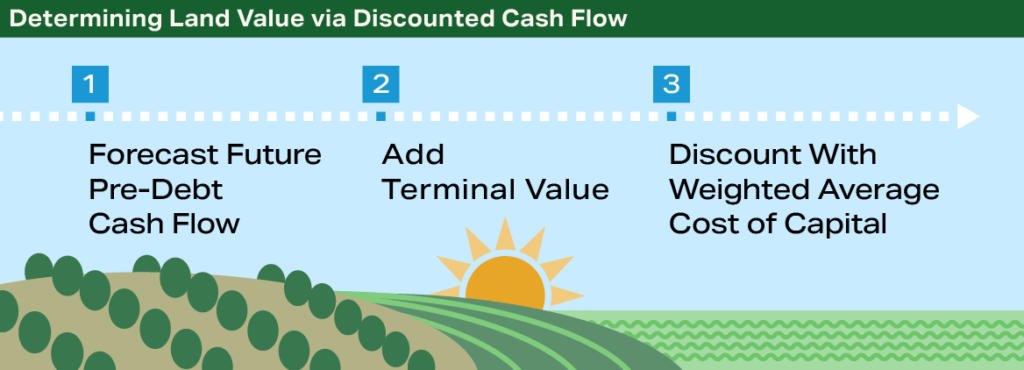
Step 1
The initial step is forecasting future pre-debt cash flow on an annual basis. This is done pre-debt because it allows us to put a value on an asset independent of how it might be financed. While there is no fixed rule for how many years projections should extend, the key is to balance near-term cash flow detail with long-term uncertainty. It is in this step where experience and judgment regarding the trajectory of agricultural commodity markets can really make a difference.
Step 2
Because farmland is a long-lived asset, however, a high proportion of its value will lie beyond the chosen income forecast period. To account for the rest of the asset’s lifespan, the next step is to estimate a property’s terminal value — the value of all cash flows beyond the chosen forecast period expressed as a single value which, in turn, is itself discounted back to the present. Prospective buyers can estimate a property’s terminal value using the Gordon Growth Model or assume an exit price through resale after the chosen forecast. For example, assume a set annual appreciation and sale of the asset at the appreciated value in the final year.
Step 3
Once the income stream is defined, the next step is discounting the income into today’s dollars. Discounting, a way to determine the present value of future cash flows, is critical since:
- A dollar today is worth more than a dollar tomorrow due to inflation
- There is opportunity cost of investing in farmland as opposed to other investments
- There is uncertainty surrounding future cash flows
A property that is expected to be riskier due to its water availability or yield variability, for example, will require a higher discount rate. Discounting also allows income earned at different points in time and across different opportunities to be comparable.
In practice, estimating a discount rate is one of the more challenging aspects of the analysis. While market-based approaches may rely on implied rates of return from existing sales or benchmark rates adjusted for risk, a more decision-relevant measure for individual operators is their weighted average cost of capital (WACC), which reflects their blended cost of debt and equity.1 Using WACC allows the model to estimate what price is supported by the income stream given the investor’s required return.
While looking to recent transactions should still inform decision-making, they do not reveal the income and returns that support those prices.
A Sophisticated Decision-Making Framework
Taken together, these steps incorporate variables that are most important to the success of the farm (such as price, yield, production cost and risk) into a sophisticated decision-making framework for a large purchase.
While looking to recent transactions should still inform decision-making, they do not reveal the income and returns that support those prices.
By using this framework, a prospective buyer can see what land is selling for and understand the return assumptions required to justify the list prices in their area. This is especially useful in periods of farmland market uncertainty.
Putting the Model to Work
Let’s consider an example of open land for an almond development with an assumed orchard life of 25 years. Almonds, like other permanent plantings, present an especially interesting case since cash flows are highly negative in the years of establishment and don’t become positive until the trees mature.
On the revenue side of the cash flow, the average almond price is held constant throughout the life of the orchard. Yields, on the other hand, vary according to a typical pattern where production is zero in the first two years; rising to 500 pounds in third leaf; 1,000 pounds in fourth leaf; 1,900 pounds in fifth leaf; and stabilizing at 2,500 pounds in sixth through 15th leaf. Thereafter, yields decline 1% per year to reflect aging. Terminal value assumes unlevered free cash flow growth at 2% in perpetuity off of median cash flow. Note that this is equivalent to assuming a 7% annual appreciation on land purchased for $10,000 per acre for the development.
On the cost side of the cash flow, we use cash costs for orchard establishment and production from the 2024 UC Davis Cost Studies for Northern SJV as a rough guide. From Year 1 to Year 3, the cumulative cost of establishment is just over $18,000 per acre. By Year 4, cash costs for production are $3,500 per acre and increase by 2% thereafter, matching typical long-term inflation.2 Because tax treatment will vary by operator, it’s not considered here.
The model evaluates outcomes across a range of almond prices and WACC rates, illustrating how land values respond to changes in key assumptions. As higher interest rates increase a buyer’s cost of capital, for example, WACC rises and reduces the value the income stream can support. Conversely, higher expected almond prices increase projected cash flows and, in turn, the value supported by those returns.
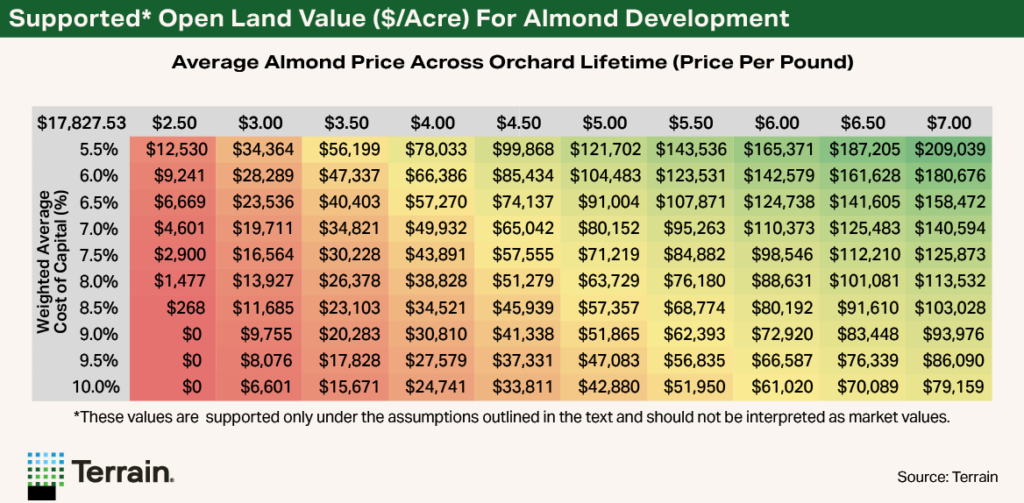
The model shows how the value supported by income might compare with an actual opportunity. Rather than relying solely on recent transactions, it allows potential buyers to evaluate whether those prices are consistent with their own assumptions about the almond market. Though the example here considers almonds, the framework is relevant to all California commodities.
The Good and the Bad
While the DCF is a powerful tool, it also has limitations. First, results are highly sensitive to underlying assumptions, as the table shows. A slight change in the almond price or WACC can shift values dramatically. Given the difficulty of precisely estimating inputs, distinguishing between what can be measured and what must be assumed is critical.
Second, DCF analysis does not fully capture strategic considerations that often influence real-world transactions. For example, buyers utilizing a 1031 exchange to defer capital gains may be less price-sensitive due to timing constraints. Similarly, operators may be willing to pay a premium for a property that has sentimental value or is adjacent to their existing operation.
Nevertheless, stress-testing your assumptions is an important part of evaluating a major investment. Understanding the expectations built into the price you’re willing to pay can help you make a more informed purchase decision and provide some clarity to a very uncertain market.
1 If you’re borrowing at 60% of the property’s purchase price at 7% and the next best opportunity for the equity you put into the property is 10%, your WACC would be 8.2%, assuming away tax.
2 We assume the prospective buyer has some scale and therefore use lower cash costs than the UC Davis Cost Study as a reasonable approximation, rather than as a precise estimate.


Terrain content is an exclusive offering of AgCountry Farm Credit Services,
American AgCredit, Farm Credit Services of America and Frontier Farm Credit.