



Quarterly Outlook • June 23, 2026
Weather Takes Strawberry Farmers on a Wild Ride

Report Snapshot
Situation
The California strawberry season started unusually early, bringing strong yields and weak prices. More recently, volumes have fallen and prices have increased.
Finding
Grower profitability will depend on how these short-term swings interact with long-term, structural factors. Operations able to maintain strong yields while managing higher production costs are likely to remain profitable.
The California strawberry industry got off to a quick start this season. Volumes started to ramp up about three weeks early, with much higher trays per acre compared with the previous year. According to the five-year average, yields in March are typically 30 to 70 trays per acre, whereas they were 80 to 150 per acre this year, per the California Strawberry Commission. This puts cumulative volume at 97 million trays, versus a five-year average of 85 million, creating downward pressure on prices initially.
The larger early-season crop was mostly driven by hotter weather. Temperatures in February and March, for example, were higher than usual.
In addition to weather, the commission expects California strawberry acreage to be 43,726 acres in 2026, a 5% increase from 2025. This is a result of an increase in acreage planted in the fall (for winter, spring and summer production), which offsets a drop in acreage planted in the summer (for fall production).
Volumes for the rest of the season will be a balance between higher acreage and weather damage.
More recently, however, market conditions shifted sharply, with weekly volumes plateauing. While cumulative trays are still up from the five-year average, current volume is now well below it. This has, in turn, lifted prices from $7-$10 per tray to $10-$16 per tray, which is above the five-year average.
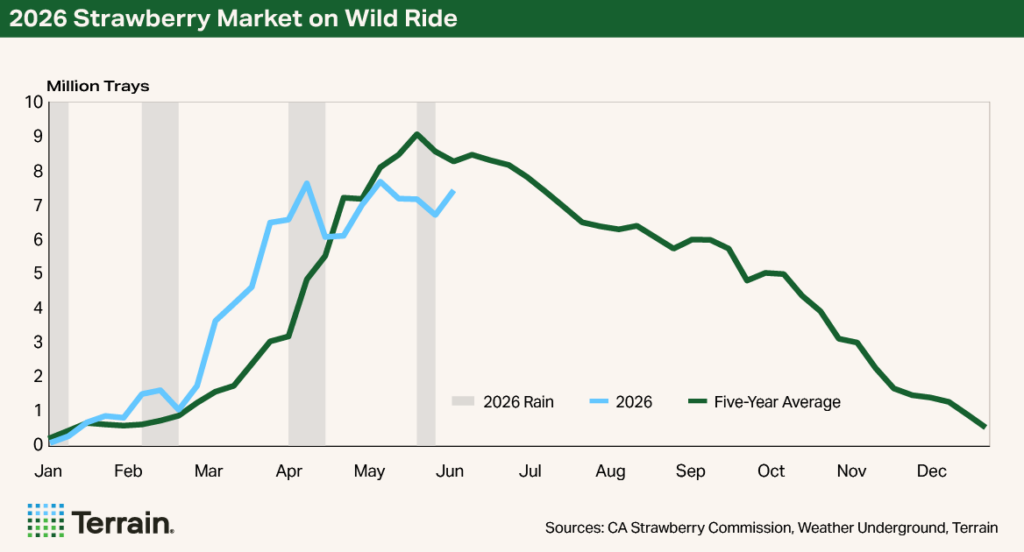
The most likely explanation for the production drop is, once again, weather. Colder temperatures and rain hit California in early April and late May. Rainy weather can do significant damage to strawberries by causing the fruit to burst or split and mold. Volumes for the rest of the season will be a balance between higher acreage and weather damage.
On top of these season-specific factors are several structural ones that continue to affect grower profitability, such as water, labor and the overall regulatory landscape. Many of these variables will resonate with producers across the state, yet it’s worth noting that the cost of production for strawberries is higher than any other crop, according to the UC Davis Cost Studies. In UC Davis’ latest estimate, an acre of strawberries costs $112,694 to grow, harvest and market in Santa Cruz, Monterey and San Benito counties.
One ongoing structural factor that’s working in favor of strong grower returns is sustained demand.
Individual Factors Will Matter for Returns
The key question for growers is what this means for net return per acre. UC Davis estimates that breakeven above all costs for a grower yielding 9,000 trays is around $13, but this will vary. Given that weather has impacted some fields more than others, timing, location and the skill of the farmer are likely to make a big difference. Growers who applied fungicide before the rain hit to prevent mold, for instance, are much less likely to experience significant yield loss.
One ongoing structural factor that’s working in favor of strong grower returns is sustained demand. Strawberries are the second-highest-selling fruit in U.S. supermarkets, with $5.4 billion in sales, according to the California Strawberry Commission. Furthermore, retail promotions for strawberries during the 2025 season generated a more substantial sales increase relative to other berries — another indication that demand is strong if this momentum can bleed into the current season.
Outlook
Given the delicate nature of the crop, strawberries are particularly vulnerable to outside forces like disease and weather disruptions, causing sharp swings in the market. This is especially evident in 2026, where weather has been unusual. Grower profitability for the 2026 season is likely to be highly variable and depend on several individual farm and farmer factors.


Terrain content is an exclusive offering of AgCountry Farm Credit Services,
American AgCredit, Farm Credit Services of America and Frontier Farm Credit.