





Report Snapshot
Situation
The May World Agricultural Supply and Demand Estimates (WASDE) report provided the USDA’s first projections for the 2026/27 marketing year, which include lower ending stocks, higher global consumption, and tighter global stocks-to-use ratios for corn and soybeans. Volatile energy markets from the Iran war continue to influence crop markets through both biofuels’ demand for feedstocks and crop production costs.
Outlook
Tightening U.S. and global balance sheets against a backdrop of volatile energy markets and speculative positioning mean producers should consider a combination of risk management tools that protect price floors but leave them in a position to capture market upside potential.
The May WASDE report provides the USDA’s first projections for the new marketing year. Future updates will incorporate changes in the agency’s projections for acreage, weather, trade partnerships and global economic conditions — all of which influence supply and demand.
Between the USDA’s June Acreage Report and the National Weather Service’s summer forecast of above-normal temperatures and near normal precipitation across much of the Midwest, uncertainty persists around planted acres and yield potential for corn and soybeans.
Compounding this uncertainty is the ongoing war between the U.S. and Iran. Crude oil has re-emerged as an important outside market for corn and soybean prices. Nearby West Texas Intermediate (WTI) crude oil futures averaged between $100 and $105 per barrel during the first two weeks of May. At those levels, energy markets are once again influencing crop values, as ethanol and renewable diesel economics improve when petroleum prices move higher.
This matters because biofuels represent a major share of end-user demand for both crops. The USDA estimates ethanol will consume 5.6 billion bushels of corn in marketing year 2026/27, or about 35% of total U.S. corn use, while soybean oil used for biofuel is projected at 17.8 billion pounds, or about 54% of total U.S. soybean oil use. For soybeans, the USDA also projects 2026/27 crush at 2.75 billion bushels, or 61% of the crop’s total use, reinforcing how closely soybean values are tied to crude oil demand and the broader energy complex.
The speculative side of the market is also adding fuel to the story. In the latest Commodity Futures Trading Commission data, for the week of May 12, managed money in corn held 420,654 long contracts against 121,171 short contracts, leaving funds net long 299,483 — the second-highest level of speculative optimism since February 2025 and near levels seen during the start of the Russia-Ukraine war. In soybeans, managed money was also firmly net long at 214,815 contracts, suggesting the funds remain a bullish tailwind.
For corn, the message is that prices are supported by steady ethanol demand, strong fund length, and tightening global supplies.
Corn: Strong Demand Meets Shrinking Supply
For corn, the message is that prices are supported by steady ethanol demand, strong fund length, and tightening global supplies.
- U.S. ethanol production remains solid at 1.082 million barrels per day (after peaking at 1.120 million in mid-April), keeping a firm pull on corn demand as long as crude oil stays elevated.
- At the same time, speculative funds remain heavily net long, increasing both upside and downside risk if energy markets weaken.
- Beyond biofuels, global fundamentals are also tightening, as world ending stocks for 2026/27 are forecast to be at their lowest level since marketing year 2013/14. Brazil is expected to consume approximately 70% of its corn production domestically, up 4.3 percentage points from its five-year average, leaving exportable supplies more limited to the global marketplace.
While the U.S., Brazil, Argentina and Ukraine together account for over 89% of global corn exports, less exportable supplies relative to total supply from Brazil and a 5 million-metric ton, or 12%, decline in exports from Argentina suggest that global importers may rely more heavily on the U.S. — reinforcing underlying support for corn prices.
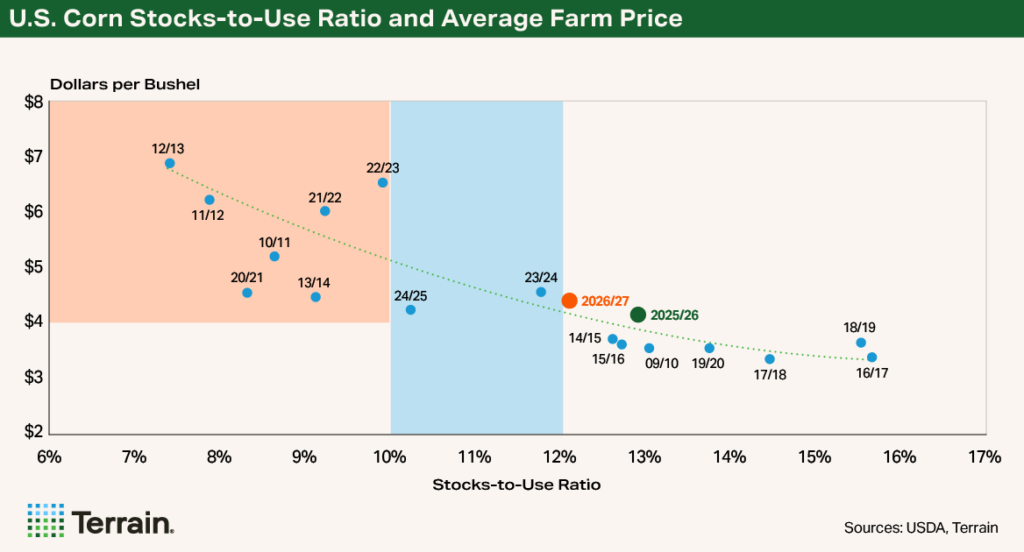
Currently, the new-crop U.S. corn stocks-to-use ratio is forecast at 12.1%, almost a full percentage point lower than projected for the current 2025/26 marketing year.
- Production is forecast to decline by over 1 billion bushels due to both a forecast reduction in planted acres from last year (based on the March Prospective Plantings report) and a return to trend-line yields of 183 bu./ac.
- Total use is forecast to decline by just 250 million bushels, leading to a tighter forecast stock position in the year ahead, supporting prices.
Historically, we begin to see the potential for higher prices when the stocks-to-use ratio approaches 12%, with notably higher prices having been observed when that ratio drops to below 10%. In this lower stocks-to-use range, the range of possible farm price outcomes widens too, with a nearly $2.50/bu. range observed historically.
The soybean market story is similar to corn’s, driven by increased demand for soybean oil used in biofuel production and strong domestic crush.
Soybeans: Strong Crush, Fragile Exports
The soybean market story is similar to corn’s, driven by increased demand for soybean oil used in biofuel production and strong domestic crush. The USDA’s 2026/27 season-average soybean oil price forecast of 70 cents/lb. reflects ongoing support from the biofuel sector, and that support flows directly into crush margins and whole-bean valuation.
The broader takeaway is that the 2026 market will likely entail heightened market volatility.
With funds still carrying a sizable net long in soybeans, the market has structural support from renewable fuels demand, but it is also more exposed if crude oil retreats or if enthusiasm around biofuel policy and soybean oil fades. Competition from South American supplies and trade relations with China will also remain primary factors influencing the U.S. soybean market.
The broader takeaway is that the 2026 market will likely entail heightened market volatility. Since corn and soybeans are feedstocks for energy-derivative products, crude oil volatility will likely play a meaningful, outsize role until stability over the Strait of Hormuz is fully realized. Large speculative positions mean market sentiment can amplify price moves in either direction.
However, do not lose sight of the supply and demand fundamentals and how these forces interplay on the corn and soybean balance sheets. In this environment, evaluating different yield, acreage, stocks-to-use and ending stock scenarios becomes essential for producers. Doing so enables more informed, risk-aware decision-making in a highly volatile and uncertain market environment.
Terrain’s Price Sensitivity Scenarios
Corn
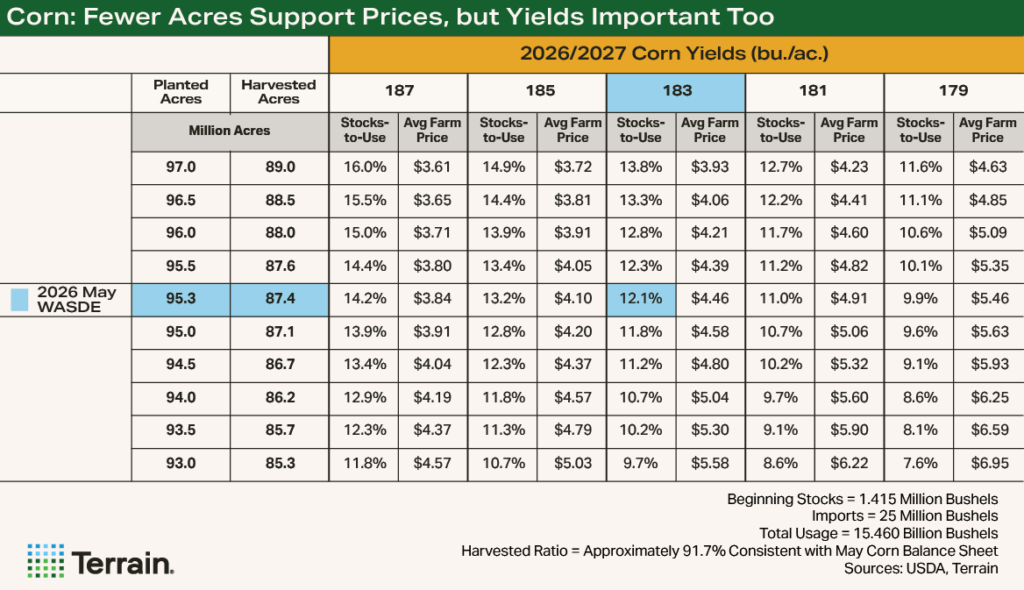
For corn, we consider a range of 93 million to 97 million acres. This 4 million-acre range is consistent with the 90% confidence interval of the March Prospective Plantings report. Harvested acres are assumed to be 91.7% of planted acres, consistent with 1.77% of average actual loss and 6.21 million acres harvested on average for silage.
The 2026/27 corn balance sheet from the May WASDE forecasts a stocks-to-use ratio of 12.1% at 183 bu./ac. yield and an average farm price of $4.40/bu. This estimate is similar to our estimate of $4.46/bu. based on our modeled historical relationship between corn stocks-to-use and average farm prices.
At the lower end of the corn acreage range (93 million planted acres and 85.3 million harvested acres), a trend line yield of 183 bu./ac. combined with 16.2 billion bushels of total use would bring the stocks-to-use ratio well below 10%. In this scenario, we expect average corn prices in the mid-$5/bu. range. This scenario might be consistent with the assumption that higher fertilizer prices will disincentivize fringe acres of corn.
The upper end of the corn acreage range (97 million planted acres and 89 million harvested acres) could push prices to or just below $4/bu., assuming trend yield levels are achieved and holding total projected use constant. This scenario might be consistent with an outcome where corn acres were under-forecast in the March report and where very few acres switched due to shifts in input and output prices of competing crops.
Even if we see higher corn acres, a 4-bushel-below-trend yield could still be manageable with the stocks-to-use ratio only falling to 11.6%, assuming the same level of overall total use. Under this scenario, corn prices would be expected to average about $4.63/bu. for the marketing year despite the higher acreage.
While we have covered two final acreage and yield scenarios, many more are shown in the table, including the combination of higher acres and yields that could push prices into the upper $3/bu. range. Or at the other extreme, where lower acres and lower yield could push average corn prices toward $7/bu. This range of possible outcomes is by no means the limit. In rare cases, outcomes outside the bounds of this table are possible.
Globally, the USDA forecasts a 1.3% decline in 2026/27 corn production to 1.295 billion metric tons (BMT) (or 51 billion bushels) due to a 0.4% reduction in area and 0.8% reduction in yields when compared with last year. Meanwhile, global consumption is forecast to increase 1.1%, or 13.7 million metric tons (MMT), to 1.306 BMT (or 51.4 billion bushels), leading to a decrease in ending stocks of 6.5%, or 19.4 MMT (764 million bushels). The stocks-to-use ratio excluding China is projected to fall from 12.2% in 2025/26 to 11.4% in 2026/27, offering some support for higher prices in the marketing year ahead.
Soybeans
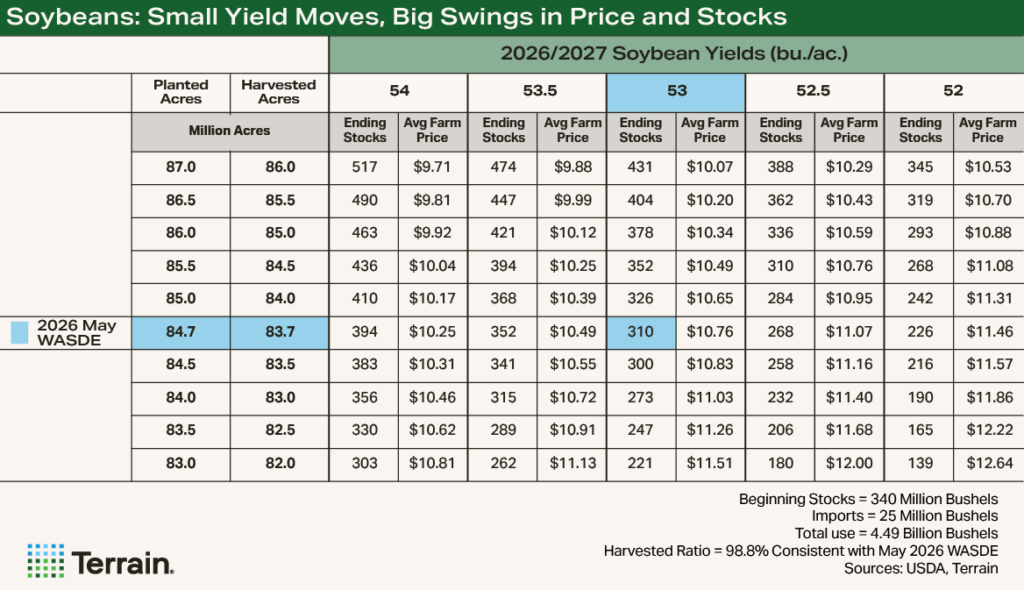
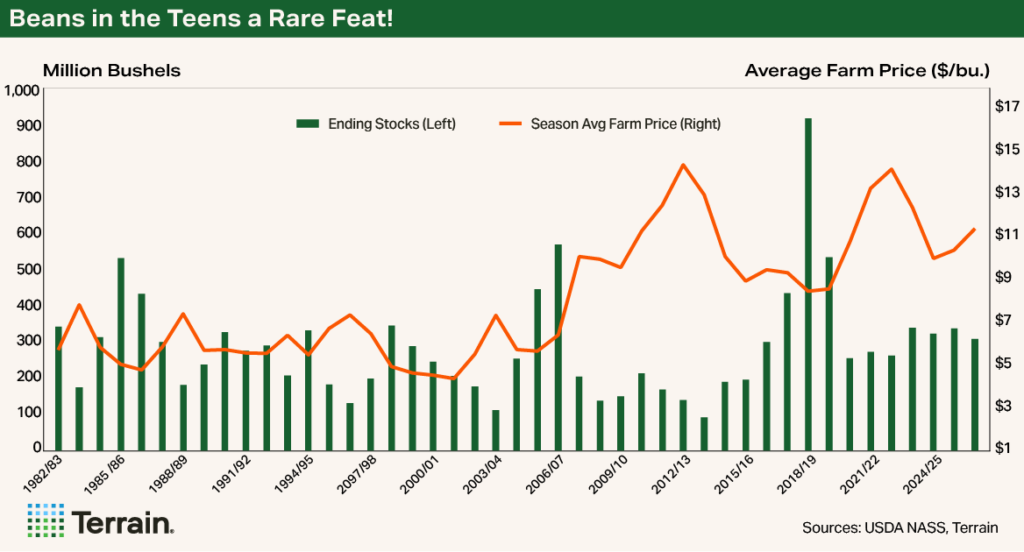
The USDA forecasts U.S. 2026/27 soybean ending stocks to tighten to 310 million bushels, below the 10-year average even in the face of rising domestic production. Planted acreage is forecast at 84.7 million, an increase of over 4%, or 3.5 million acres, from last year’s 81.2 million acres. The USDA forecasts yield per harvested area at 53 bu./ac., matching last year’s record and making production the second largest on record at 4.435 billion bushels (after 2021/22). The near record supplies are expected to be met with record domestic consumption of 2.86 billion bushels. With four more crush plants becoming operational throughout 2026, domestic crush is forecast at a record 2.75 billion bushels.
Combined with the expectation that China resumes its historical average purchases from the U.S. of nearly 920 million bushels, ending stocks will tighten year over year (YOY) from 340 million bushels in 2025/26 to 310 million bushels in 2026/27, according to the USDA.
However, based on the current pace of soybean export sales for 2025/26 (which, seasonally, are more than 95% complete by May), Terrain expects old-crop ending stocks to increase another 30 million bushels, which would raise beginning stocks for 2026/27 accordingly. Unless crush truly increases by another almost 5% or more in 2026/27, the USDA’s current demand forecast and ending stocks appear a tad too rosy. If old-crop ending stocks rise, and new-crop ending stocks rise proportionally, assuming 53 bu./ac. average yields, the season-average farm price would likely hover around $10.50-$10.60/bu.
Soybeans have nearly a $3 range of price scenarios. If domestic planted acres continue to climb in reports in the months ahead because of rising input costs, and demand does not materialize according to the USDA’s current optimistic forecast for both old and new crop, ending stocks will rise and pressure prices.
However, if farmers plant according to the USDA March intentions report, new-crop demand would have to increase significantly beyond the current forecast for U.S. ending stocks to tighten below the 150 million-bushel threshold. Additionally, season-average farm prices have exceeded $13/bu. for the entire marketing year only twice in history: during the drought of 2012 and following the Phase 1 U.S.-China trade agreement in 2021. The market will need an event of this magnitude to repeat history again, making the likelihood of pushing soybean prices past the $13/bu. threshold a difficult feat.
Globally, the USDA forecasts record soybean supplies in 2026/27, with production increasing over 3% compared with 2025/26 to 441.5 million metric tons (MMT), led by Brazil’s ever-persistent production expansion, which is forecast at 186 MMT (a third-consecutive record), up over 3% or 6 MMT compared with 2025/26. Brazil’s domestic crush is expected to increase 3.5 MMT, but the additional surplus of 2.5 MMT could pressure future U.S. exports in the global market.
The USDA is forecasting record global exports at nearly 190 MMT. More than 60% of the YOY import increase is tied to a single customer: China. The USDA expects an almost 2% rise in imports from the world’s largest buyer, with the current import forecast for 2026/27 at 114 MMT. However, China’s own agricultural ministry in May 2026 forecasts the country’s soybean imports at just shy of 96 MMT, down over 7% YOY and more than 15% smaller than the USDA’s forecast.
If China’s forecast becomes reality, that will leave 2026/27 global ending stocks 18 MMT higher than the USDA’s current forecast. Without increased demand from China, global stocks will rise, keeping a lid on prices.
For soybeans, expect continued price volatility with a high probability of domestic and global supplies rising amid questionable global demand. Luckily, domestic crush will continue to be strong in the U.S., which will help offset a portion of export demand if the expected sales from China do not fully materialize.
While we have a long time before South America’s supplies for 2026/27 will truly be known, if global supplies continue to climb, this could keep a lid on soybean price upside potential.
Prepare and Be Ready to Act
With corn and soybean prices increasingly influenced by global supply and demand shifts, speculative positioning, and now volatile energy markets, producers should lean on a combination of marketing tools to protect price floors while managing risk that could capture future upside.
Volatile market rallies can provide opportunities to layer sales incrementally through forward contracts and hedging strategies rather than waiting for a single price target.
Monitoring Commitment of Traders reports can add valuable context: Heavy managed money length often signals that upside is becoming more sentiment-driven to the supply and demand situation, but it also leaves the market vulnerable to liquidation if the situation (or headlines) turns negative.
Pairing futures or cash sales with option strategies can help protect downside while keeping some upside flexibility in case the weather market becomes favorable to prices during the summer.
Risks are high in 2026, but so is opportunity.
The objective isn’t to time every move perfectly in today’s volatile environment, but to combine risk management strategies and market awareness to protect margins and capture upside opportunity.
Risks are high in 2026, but so is opportunity. When risk is high in a margin-compression environment, it’s important to know, understand and visualize how your expected margins compare against a range of supply and demand outcomes. With volatile markets likely continuing in 2026, it is important to work with your Farm Credit lender to talk through and review your cost and revenue assumptions and what they mean to your overall return.


Terrain content is an exclusive offering of AgCountry Farm Credit Services,
American AgCredit, Farm Credit Services of America and Frontier Farm Credit.