



Quarterly Outlook • June 25, 2026
From a Viral Trend to a Pistachio Market Mover

Report Snapshot
Situation
While profitability across many Central Valley crops has remained under pressure, pistachios continue to stand out as a bright spot.
Outlook
Even with a significantly smaller crop expected in 2026, stable prices are likely to support another profitable year for many growers.
Profitability has persisted even as production has continued climbing.
Over the past several years, pistachios have stood out as an exception among California permanent crops. While almonds, walnuts and wine grapes have struggled with weak profitability due to oversupply, inflation and elevated interest rates, pistachio returns have remained comparatively strong.
What makes pistachios especially notable is that profitability has persisted even as production has continued climbing. According to the Administrative Committee for Pistachios, in 2023, California pistachios had a record crop of 1.5 billion pounds, which concerned those in the industry who worried about overproduction. In 2025, the industry beat its previous record with a 1.6 billion-pound crop, a 484% increase from the 2015 crop size, all while keeping prices in check.
Exports increased 223% from the 2014/15 crop year to the 2024/25 crop year.
So, what’s keeping the price high? Extremely strong demand is a primary driver.
Availability per capita in the U.S., a proxy for demand, increased from 0.23 shelled pound per person in the 2015/16 crop year to nearly 0.70 pound per person today. This is not to mention the incredible growth in demand globally, where export shipments have also consistently broken records in recent years. Exports increased 223% from the 2014/15 crop year to the 2024/25 crop year.
Pistachios’ emergence as a popular ingredient should continue to be a tailwind for growers.
Nowhere is this demand clearer than in the Dubai chocolate phenomenon. First released in 2022 by a chocolatier in Dubai, the popularity of the dessert went viral with variations of the product released by Lindt, Sprungli, Trader Joe’s, Haagen-Dazs, Crumbl Cookies, Shake Shack, Starbucks and many others shortly after. While Google search interest of the term peaked in March 2025, it’s hardly fizzled. Pistachios’ emergence as a popular ingredient should continue to be a tailwind for growers.
Supply has generally been rising with demand, but supply is likely to turn tighter soon. Though this season was projected to be an off-year for the crop (pistachios alternate-bear), hotter-than-typical early weather is also contributing to what appear to be reduced yields, particularly for acreage south of Fresno County. Some farmers have speculated that total crop receipts could be as low as 700 million to 900 million pounds, potentially less than half of the 2025 crop.
In addition to California’s own supply dynamics, production from other parts of the world is also expected to be down. Iran, the second-largest producer with about 18% of global production, is unlikely to be able to export its crop anytime soon given unrest in the Middle East. Turkey’s production, which accounts for about 11% of global production, is expected to be down as well due to a combination of it being an off-year and the impact of frost and drought, according to the USDA.
So, what might these dynamics mean for the average grower? One way to evaluate potential outcomes is through a sensitivity table examining different yield and price combinations.
For this analysis, I assume total operating costs of roughly $3,500 per acre and a weighted average pistachio price based on a crop mix of 85% in-shell product and 7.5% kernels, accounting for shell removal during processing. While some operating costs increase with yield, those changes are assumed to be zero for simplicity.
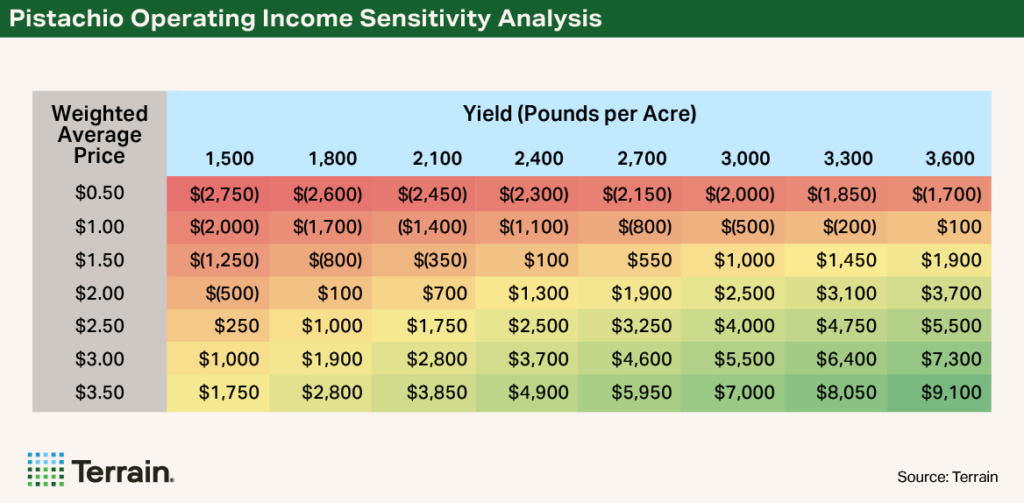
The table highlights a wide range of profitability outcomes depending on where yields and prices ultimately land. For pricing, I assume an average return of $2.50 per pound, which may prove conservative given the likelihood of lower supply with continued strong demand.
Assuming approximately 547,000 bearing acres (based on 2025 bearing acreage plus 2020 new plantings now entering production) and total output around 800 million to 900 million pounds, the analysis suggests profitability is still likely to remain strong for many pistachio producers despite lower yields. For some growers, however, this may mean reliance on crop insurance.
Looking Ahead
California pistachio yields in 2026 are likely to fall well below last year’s levels. At the same time, prices are expected to remain steady or potentially move higher. Understanding where your operation may fall within different price and yield scenarios can help inform management decisions throughout the season.
Although it is difficult to define an “average grower” given the wide variation in factors like yield and production costs, current market conditions suggest 2026 is likely to be another profitable year for many California pistachio producers.


Terrain content is an exclusive offering of AgCountry Farm Credit Services,
American AgCredit, Farm Credit Services of America and Frontier Farm Credit.