



Quarterly Outlook • July 7, 2026
Drought Likely Dashing Hopes for Expansion

Report Snapshot
Situation
Drought conditions continue. Long-term weather forecasts expect the El Niño influence on precipitation to increase in late summer and early fall, well past the time that it could help many operations.
Finding
Beef cow slaughter levels remain below year-earlier levels, but drought-induced culling is taking place.
Outlook
Beef cow herd expansion will be small, if it occurs at all, going into 2027, continuing the trend of higher prices. For the second half of 2026, prices for all classes of cattle and beef will likely climb but at a slower pace than during the past 12 to 24 months.
Hopes of increasing the U.S. cattle herd are on hold again.
My analysis of recent pasture and range condition data shows that more than three-quarters of the beef cow herd are under drought conditions. Pacific sea surface temperatures have warmed into El Niño territory, and there are now better than two-thirds odds that it will be a strong or very strong event.

Beef cow slaughter levels remain below year-earlier levels even as drought-induced culling is taking place on many operations. Auction market data in the Northern Plains show increasing numbers of very light calves being sold off ranches, likely the results of early weaning programs or splitting cow-calf pairs upon their arrival at the auction market. Many of these cows were likely headed for slaughter.
Adding to the feeder cattle and calf supply deficit, New World screwworm (NWS) has entered the U.S. via the Texas-Mexico border, making it harder for surrounding farms and ranches to move cattle farther north. The NWS confirmation also appears to have put the reopening of the U.S.-Mexico border to live cattle trade on hold.
For now, it appears that drought conditions and heifers leaving ranches due to limited feed availability are the only potential for an increase in available feeder cattle and calf supplies for the foreseeable future. These are not avenues for sustained herd expansion.
Packer Capacity Erodes
On May 20, the ongoing labor dispute at Cargill’s Fort Morgan, Colorado, beef slaughter and processing plant escalated with the company locking out its nearly 1,700 union employees. The company and union representatives had been in tense negotiations to renew their expired contract. The talks culminated in a 90% union rejection of a five-year contract offer.
Packer slaughter capacity still outpaces cattle availability by 6,000 to 8,000 head per day.
Because the plant, which can process up to 4,700 head per day, had not slaughtered cattle since the third week of April, the futures market reaction to the lockout news was limited. By mid-June, front-month live cattle futures prices had rallied above prices that existed on the day of the announcement.
Cattle feeders still have the upper hand, albeit less so, when it comes to leverage in the marketplace. Packer slaughter capacity still outpaces cattle availability by 6,000 to 8,000 head per day.
Packer margins remain negative, ranging from -$200 to -$300 per head. I don’t expect them to improve during the summer, and they may worsen if beef prices falter.
Average cattle carcass weights reached their lowest levels of 2026 to date during the last week of May but were still 31 pounds per head above last year. Following a similar pattern, the percentage of cattle slaughter that graded Choice or Prime has declined week over week since late April.
Beef demand and consumer spending remain resilient.
Combined, these trends are both following a normal season pattern and hint that cattle feeders have gotten slightly more current in their marketing of finished cattle. The market missed the fact that the reported May slaughter rate was nearly 5% larger than the pace from January to April (-8.6% year over year).
Consumers Still Choose Beef
Beef demand and consumer spending remain resilient, despite consumer sentiment measures for the whole economy waning due to rising fuel costs and rising inflation dashing the odds of an interest rate cut by the Federal Reserve. The Fed chose to keep overnight interest rates steady at its mid-June meeting.
I expect cattle slaughter in Q3 2026 to run 2% to 4% below year-earlier levels.
According to 201 Analytics and Circana retail grocery scanner data analysis, May beef sales volume declined about 1.4% compared with a year earlier and sales dollars declined for the first time in many months. This isn’t to say that demand declined; we’ll have to wait for the May trade data to be sure, as retail prices were still 13% above a year prior. Likely the worst thing you can say about demand is that the rate of growth slowed but remained positive.
Production and Price Expectations
I expect cattle slaughter in Q3 2026 to run 2% to 4% below year-earlier levels and beef production in Q4 2026 to run 3% to 5% below 2025 levels. The increase in average fed-cattle dressed weights will likely offset 3% to 3.5% of the slaughter decline. In this scenario, continued record-high imports could cause net beef supplies and per capita consumption to increase about 1% for the last two quarters of 2026. Rising retail prices during summer will equate to continued robust beef demand.
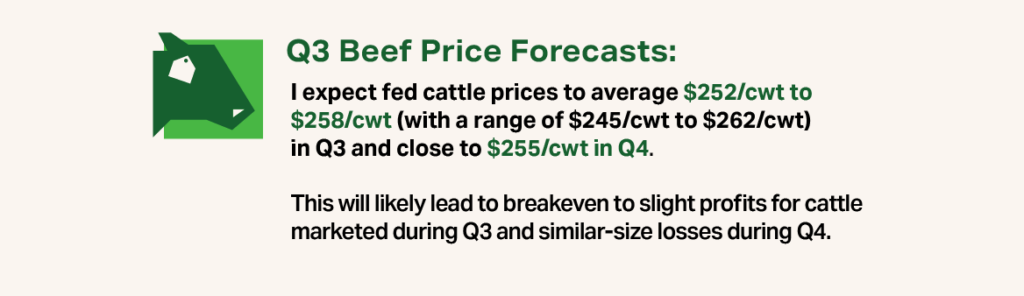
Feeder cattle prices will likely break out of the near sideways trade it was in during May and June and rally from $370/cwt in early July to nearly $410 late September — averaging $385/cwt to $390/cwt for Q3 and $395/cwt to $405/cwt for Q4.
I expect Oklahoma City 450-lb. steer calves to be in mostly rally mode through Q3, with prices rising from near $500/cwt early on to $555/cwt by late Q3. In Q4, I project they’ll range from $540/cwt to $560/cwt.
These forecasts are slightly below prior expectations given slower-than-expected growth in beef demand; shifts in leverage between food service and grocery outlets, packers, and feedlots; and building cattle-on-feed supplies. Even so, the forecasts remain record high because of still-strong beef demand and historically short supplies.


Terrain content is an exclusive offering of AgCountry Farm Credit Services,
American AgCredit, Farm Credit Services of America and Frontier Farm Credit.