





Report Snapshot
Situation
While the Iran conflict has added upward pressure to wheat prices, both upside and downside price risk related to the conflict will remain in the quarter ahead. Spring weather forecasts and foreign supplies will also shape wheat prices.
Outlook
For Q2, I forecast hard red winter prices to remain in the mid-$5/bu. range and soft red winter prices to remain in the mid- to upper-$5/bu. range. I forecast spring wheat prices to rise to average between $6.30/bu. and $6.50/bu. in the 2026/27 marketing year.
Impact
Consider whether protecting against downside price risk fits into your risk management plan now that prices have moved higher than where they have been over much of the past quarter.
The price outlook for wheat broadly over the next quarter will remain heavily influenced by the Iran conflict, with spring weather forecasts and foreign supplies also contributing to the outlook. I expect significant volatility to continue, creating opportunities to market wheat over the next quarter as we move toward winter wheat harvest.
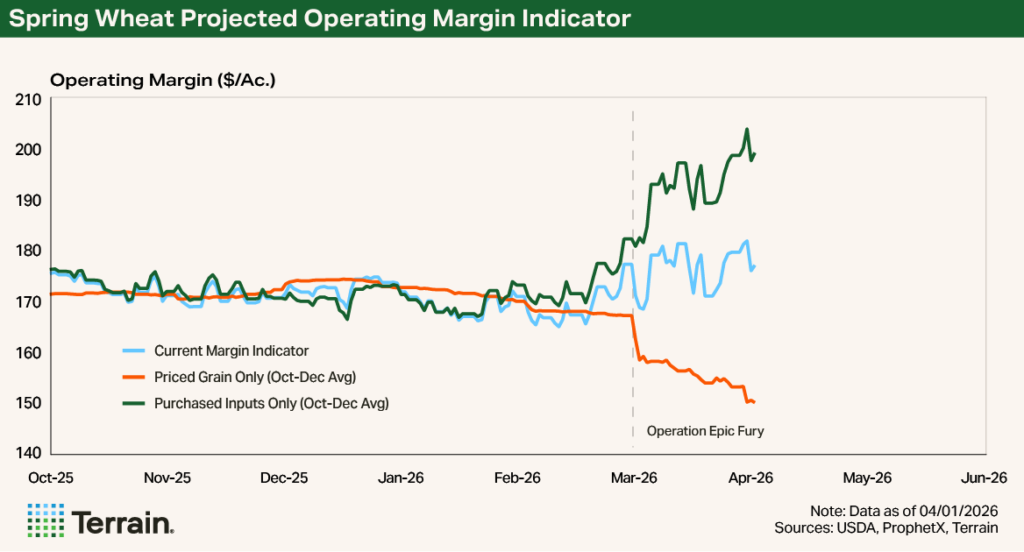
Despite this possible net improvement in operating margin for some, overall margin levels remain near break-even levels.
Epic Fury of Margin Volatility
The projected 2026 operating margins for spring wheat have been highly volatile since Operation Epic Fury began in Iran, with daily swings averaging $2/ac. (and up to $8.50/ac.). Yet they have remained largely in line with pre-conflict levels when comparing current expected prices to current production cost estimates.
Like other crops, the margin for any individual farm will depend on when inputs were purchased and when (or if) anticipated production has been priced. For those who purchased inputs before March 1, their margin has improved. For most farms, the outlook most likely falls somewhere in the middle.
Weather will continue to play an important role in the spread between U.S. wheat classes.
Drought Drags On
Weather will continue to play an important role in the spread between U.S. wheat classes. As of March 24, 57% of U.S. winter wheat is under some form of drought designation, with an additional 27% experiencing dry conditions.
Since the start of 2026, the first two drought classes (D0 and D1) have seen a noticeable increase while severe drought classes (D2 and higher) have remained relatively steady at 15% to 20% of winter wheat. Most of this increase has been in the hard red winter (HRW) growing areas of Kansas, Oklahoma and Texas, though wheat areas in the eastern corn belt and northern Mid-South also remain dry.
While parts of southern South Dakota remain under a drought designation, spring wheat areas north of that are forecast to be largely drought-free through planting.
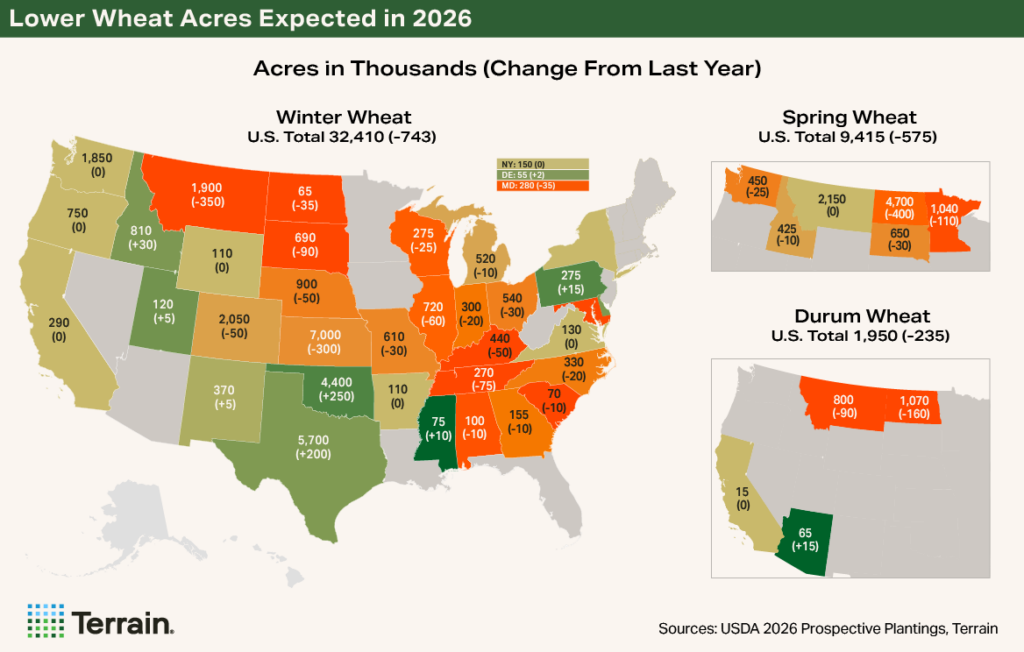
The USDA estimated in its March 31 Prospective Plantings report that farmers intend to plant 9.4 million acres of spring wheat, down 575,000 acres from last year. Durum wheat acres may fall by 235,000 acres to 1.95 million acres. Winter wheat planted area estimates were also revised lower to 32.41 million acres from 32.99 million in January.
Notable declines are expected in North Dakota and Montana, with a combined loss of over 1 million acres from last year across winter, spring and durum wheat. Notable gains are expected in Texas and Oklahoma, adding a combined 450,000 acres of winter wheat from last year.
Wheat markets outside the U.S. are expected to remain well supplied in the first half of the 2026/27 marketing year.
Carryover Cushions Global Supply
Wheat markets outside the U.S. are expected to remain well supplied in the first half of the 2026/27 marketing year. Carryover stocks will largely offset lower production that’s expected due to lower area, a return to normal yields, or both across key markets. It is therefore unlikely that U.S. wheat exports have a significant rally over the next three months. Later in the year, markets could tighten if export prospects from the Southern Hemisphere crops fall significantly.
Key Market Export Forecasts:
- Canada intends to plant 1.1% fewer wheat acres, according to its March Principal Field Crop Areas report, with canola, corn and soybeans expected to gain acres over last year. At normal yield levels, exports are forecast to fall 4% to 27.8 million metric tons (MMT).
- In the Black Sea region, the prospects are for lower total wheat area in both Russia and Ukraine as they face tight margins. In both countries, oilseeds or corn are expected to gain area from wheat because of profitability. However, exports could rise as larger total supplies (mostly from carry-in stocks) more than offset the lower expected production. Exports could rise by 8%, or 4.4 MMT, to 61.4 MMT combined in the year ahead, with stocks falling slightly.
- India is forecast to have a record-large wheat crop, now being harvested, with the latest estimates pegged at 114 MMT to 120 MMT — above last year but below earlier forecasts due to recent weather. If realized, this could increase stocks for 2026/27, keeping them at above-average levels. Limited exports have been authorized but will depend on them being price-competitive in world markets.
Continue to monitor wheat markets closely, as there could be pricing opportunities amid the volatility.
Prices Supported for Q2, but Volatility Persists
Prices across the wheat complex will remain heavily influenced by the energy and fertilizer price (and availability) situation in the quarter ahead (and possibly into late 2026). Though the length of the Iran conflict is uncertain, volatility could be higher than normal for its duration. Continue to monitor wheat markets closely, as there could be pricing opportunities amid the volatility.
HRW Price Outlook
Prices for HRW have already risen more than for other wheat because of dry weather and the potential for a smaller crop. Continue to closely monitor the weather outlook and yield prospects across the HRW regions for potential pricing opportunities.
I forecast HRW prices will remain in the mid-$5/bu. range over the next quarter and average about $5.50/bu. for the upcoming marketing year, assuming dryness reduces yields slightly and export demand remains similar to this year.
SRW Price Outlook
I forecast soft red winter (SRW) wheat prices to remain in the mid- to upper-$5/bu. range over the next quarter and average about $5.60/bu. for the upcoming marketing year, assuming average yields and exports falling slightly to 100 million bushels in 2026/27.
Spring Wheat Price Outlook
I forecast spring wheat prices to average about $5.35/bu. for the current marketing year and rise to average between $6.30/bu. and $6.50/bu. in the 2026/27 marketing year. A lower production forecast for 2026/27, combined with expected steady domestic use and exports, should tighten expected ending stocks and offer support for potentially higher prices.
Protecting Against Downside Price Risk
While my current outlook is for slightly higher wheat prices in the year ahead, there is downside risk related to weather, global demand and other factors. Currently, the Iran conflict has added upward pressure to prices, but both upside and downside price risk related to the conflict will remain in the quarter and year ahead.
Consider whether protecting against downside price risk fits into your risk management plan now that prices have moved higher than where they have been over much of the past quarter.

Terrain content is an exclusive offering of AgCountry Farm Credit Services,
American AgCredit, Farm Credit Services of America and Frontier Farm Credit.