







Report Snapshot
Situation
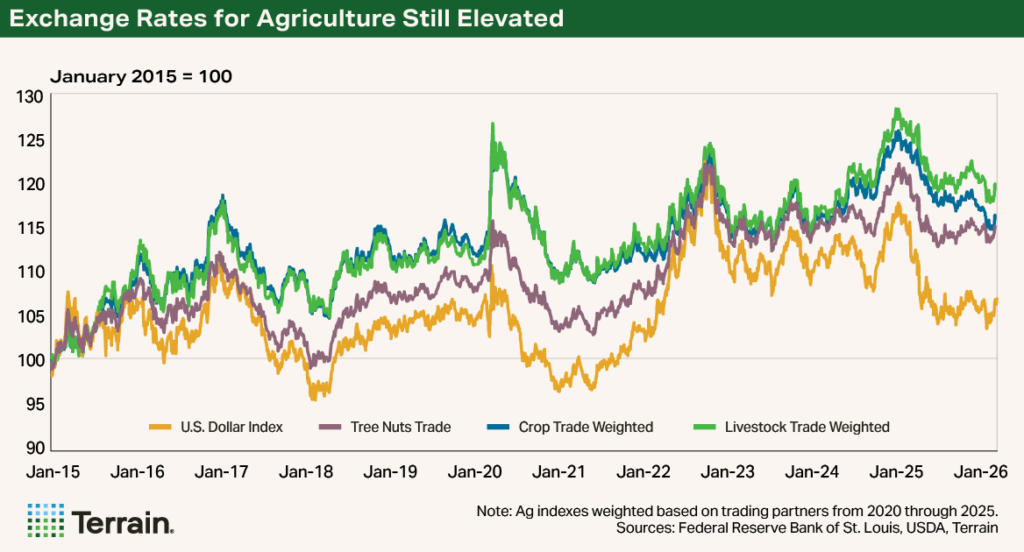
Since early 2025, the U.S. Dollar Index has dropped by over 12%.
Finding
A weaker dollar can help export opportunities, but the U.S. Dollar Index does not accurately reflect the exchange rates that influence most U.S. agricultural exports.
One of the questions I’m asked most often is how much a weaker U.S. dollar will increase exports of major agricultural products. Since the start of 2025 through early March 2026, the U.S. Dollar Index had declined more than 12% from the high to the low. It is also true that many of our commodities are oversupplied and need to find a home abroad to help clear the market for 2026 production.
U.S. Dollar a Light Tailwind, Not a Rocket
Typically, a weaker U.S. dollar makes U.S. products more competitive in the global market. However, I do not believe the current weakening of the U.S. Dollar Index will have a substantial impact on U.S. agricultural exports on its own merit.
Change in the U.S. Dollar Index is often reported as a proxy for the performance of the U.S. dollar. This index is heavily weighted toward the euro, Japanese yen and British pound — accounting for more than 80% of the index, mostly the euro. From 2020 to 2025, the EU, Japan and the U.K. accounted for about 15% of U.S. crop exports, 13% of livestock exports, and 35% of tree nut exports.
The currencies of other important trade parters, including China and Mexico, are not included in the index. Therefore, moves in the U.S. Dollar Index are not always reflective of changes to our agricultural export partners’ purchasing power.
I don’t believe the recent softness in the U.S. dollar on its own, though helpful, will be enough to significantly tip the scale for an export boon.
In 2026, the U.S. Dollar Index dipped to the lowest values since early 2022. However, when I create indexes weighted to recent trade flows for agriculture, the current levels are consistent with levels observed in 2023 and 2024. For example:
- Trade-weighted exchange rates for crops and tree nuts are only about 1.2% below the average from 2023 to 2024.
- The trade-weighted exchange rate for livestock is slightly higher today than the average from 2023 to 2024.
As a result, I don’t believe the recent softness in the U.S. dollar on its own, though helpful, will be enough to significantly tip the scale for an export boon.
Moreover, competitor exporting countries may also experience currency weakness alongside the U.S., which blunts the impact of a weaker U.S. dollar. The Brazilian real, for instance, has been weakening to the Chinese yuan long term, limiting some of the recent benefit of a weakening U.S. dollar to the yuan.
Should global uncertainty continue, the dollar may regain some ground against other currencies and cease to be a tailwind to exports.
Many agricultural products have a certain amount of price inelasticity — a fancy way of saying that consumption remains relatively stable no matter the price. So, even when an exchange rate may make an agricultural good slightly more or less affordable in another country, it does not necessarily imply a change in consumption. For example, corn, soybeans (including meal and oil), cotton and dairy products each observed one of their top export years on a volume basis in either 2020 or 2025, when exchange rates peaked.
Recent global events have led to a sharp appreciation in the U.S. dollar. In times of uncertainty, the dollar has been viewed as a safe asset. Should global uncertainty continue, the dollar may regain some ground against other currencies and cease to be a tailwind to exports.
Supply-and-demand fundamentals will continue to be the driving factor for exports.
What Farmers Should Expect
The dollar has only slightly weakened compared with the currencies of our top trade partners. This weakening can act as a light tailwind to exports, but it is unlikely to dramatically push additional, or previously unlooked for, exports. Supply-and-demand fundamentals will continue to be the driving factor for exports. The U.S. has ample supplies of many commodities and needs additional global consumption, supply shocks, or (more recently) uncertainty around future trade flows to drive additional exports.



Terrain content is an exclusive offering of AgCountry Farm Credit Services,
American AgCredit, Farm Credit Services of America and Frontier Farm Credit.