





Report Snapshot
Situation
Rising soybean acreage at home and abroad is likely to expand supplies faster than demand, leaving prices capped unless China materially accelerates export purchases.
Finding
Domestic biofuel clarity helps but doesn’t lift the price ceiling meaningfully higher. Rising demand for both soybean oil and meal will be supportive of higher crush, leading to favorable basis.
Outlook
Soybean prices will continue to see volatility. Expect any future price rallies to be tied to weather scares and geopolitical headlines.
As the U.S. spring planting season begins, the USDA March 31 Prospective Plantings report indicated farmers intend to plant 84.7 million acres of soybeans, up nearly 3.2 million acres, or 4%, from 2025. The biggest regional change is for the Western Corn Belt, with Iowa, Minnesota, Nebraska, and North and South Dakota all increasing planted area in 2026 versus 2025. The Southeast also indicates a significant increase in soybean planted area for 2026, led by Arkansas and Mississippi planting less corn, rice and cotton than in 2025.
Importantly, the March survey response rate was the lowest ever at 37%, down 7% from last year. Over 80% of the survey responses were received after the Middle East conflict began. Although no one knows how long the conflict will last, Terrain doesn’t expect a significant shift to soybeans, as many U.S. farmers had previously secured fertilizer needs.
However, other countries may strongly consider the impacts of rising input costs and choose to plant less fertilizer-intensive crops such as soybeans. If that’s the case, global supplies and ending stocks will likely rise and continue to outpace global demand — pressuring U.S. new-crop exports and prices.
However, the 2026 soybean crop has a long way to go until harvest, so weather conditions during the planting and growing season will ultimately determine yields and supplies for the new-crop balance sheet.
Farmers should carefully weigh the risk of lower prices overall against weather-related rallies that may occur during the planting or growing season.

China-Contingent Climb
Global demand for bulk soybeans continues to be volatile and questionable. It is becoming less likely that the U.S. will see additional old-crop export sales to China near 8 million metric tons (or nearly 300 million bushels) as previously promoted by the U.S. administration. As of March 1, the USDA’s quarterly Grain Stocks report indicates 2.1 billion bushels have been stored in 2026, up 10% from last year. This reflects the softer demand thus far this crop year. Based on the actual export sales pace this crop year to date, I believe the current USDA export sales forecast is still 100 million bushels (MBU) too optimistic and expect ending stocks to rise accordingly to 450 MBU, despite China’s purchases totaling 12 million metric tons (MMT).
Chinese President Xi Jinping and President Trump are expected to meet mid-May to discuss trade relations. Given China has yet to purchase any new-crop soybeans for 2026/27, new-crop export sales bookings to China during Q2 and Q3 will be critical. Anything less than 25 MMT of U.S. soybean exports to China will lead to rising stocks, pressuring prices.
Anything less than 25 MMT of U.S. soybean exports to China will lead to rising stocks, pressuring prices.
China has also resumed canola purchases from Canada, which could limit its import needs of other oilseeds like soybeans. While Brazil is experiencing some logistical delays with its soybean harvest, it is still record large. Brazil remains the cheapest global supplier, and its supplies will eventually hit the global market, limiting U.S. bulk exports.
Soyoil’s Spotlight
Late in March, the Environmental Protection Agency (EPA) set the highest levels of biofuels ever required to be blended into the U.S. fuel supply, as part of its Renewable Volume Obligations (RVOs) for 2026 and 2027. Biofuel obligations are at 26.81 billion Renewable Identification Numbers (RINs) for 2026 and 27.02 billion RINs for 2027.
The EPA also announced a 70% partial reallocation of the 2023 to 2025 outstanding Small Refinery Exemptions (SREs) to clean up the backlog. This means that the blending obligations will be even higher than the 2026 and 2027 RVOs, which leads to incremental demand for feedstocks like soyoil.
Additionally, the EPA indicated that in 2028 imported fuels and biofuel feedstocks will only receive half the RIN value of domestic fuels and feedstocks. While the EPA states that this two-year delay to the initial timeline will help biofuel producers prepare for the change in practice, it also delays the prioritization of domestic feedstocks like soyoil over imported substitutes like used cooking oil from China and tallow from Brazil.
The bottom line: The U.S. biofuel industry finally has clarity through 2027 on the blend requirements. Although the treatment of imported feedstocks remains status quo, the industry should begin to recover with biofuel production ramping up. This will help reduce soyoil stocks, which have been rising the past few months because of a record crush pace.
Soyoil Igniting Crush Margins
The conflict in the Middle East pushed up grain and oilseed prices, with the May soybean contract surpassing $12/bu. briefly in March. Soy product prices have also rallied, with May soyoil futures reaching highs not seen in over three years. As of February, cash Illinois prices are up more than 10% from a year earlier. For the first half of the old-crop year, crush margins have averaged nearly $2.60/bu., up 33 cents or nearly 15% from last crop year’s average of $2.27/bu.
The federal biofuel clarity will help keep this momentum going into the back half of the crop year and support stronger local basis to farmers near soybean crush plants.
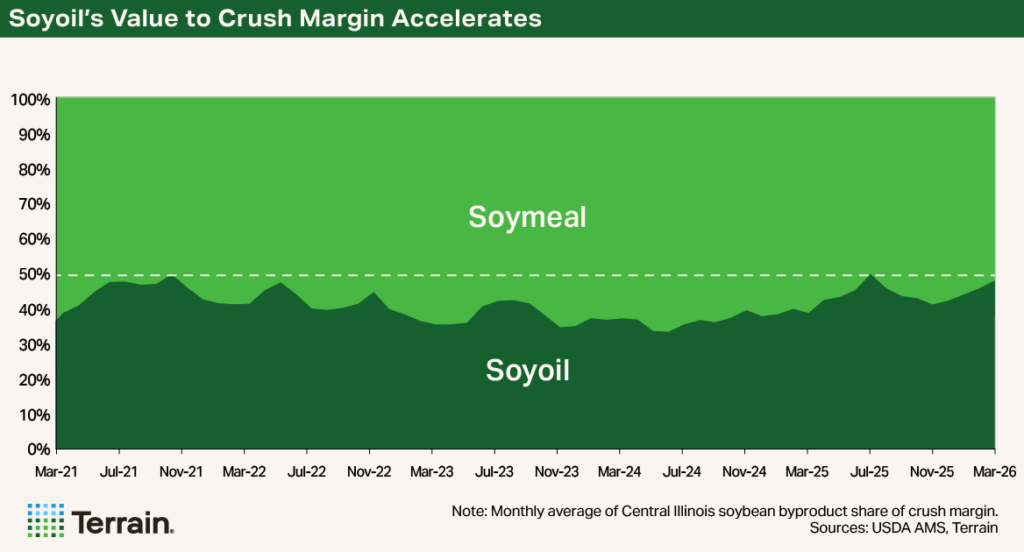
Combined with the potential for increased domestic demand in biofuel production, we might finally start to see soyoil bring most of the margin value to the crusher. The soyoil share of the crush margin has hit or exceeded the 50% threshold only two other times: in 2021 after the renewable diesel boom and in July 2025. However, the majority of the soybean crush product volume is still soymeal, so paying attention to soymeal demand will remain critical to support the future U.S. crush pace.
Soymeal Squeeze
As soymeal production outside the U.S. continues to rise, and domestic consumption outpaces production, stocks-to-use is tightening over time.
As domestic crush continues to set records, farmers located near crush plants should see basis strengthen accordingly.
According to the USDA, several major global producers of soymeal — including Argentina (the world's largest exporter), the EU and 25 other countries — are forecast to have tighter stocks-to-use in 2025/26 versus 2024/25. This puts the U.S. in an excellent position to supply the globe, increase global market share against Argentina, and further support higher domestic crush rates in the back half of the crop year.
As domestic crush continues to set records, farmers located near crush plants should see basis strengthen accordingly.

Rhetoric might drive prices in the short term, but fundamentals remain unchanged.
Beans in the Teens?
Rhetoric might drive prices in the short term, but fundamentals remain unchanged. The likelihood of both domestic and global acres rising leans bearish, with supply outpacing demand.
But uncertainty and volatility will persist.
- Mother Nature will have the ultimate say in final new-crop yields and supply, so carefully weighing any weather-related price rallies against fundamentals will be important for marketing decisions.
- On the demand side, closely watch actual old- and new-crop export sales activity from China, especially following the mid-May meeting between the U.S. and China. Unless China’s purchases of U.S. soybeans exceed the 25 MMT for new crop, prices will lean neutral.
Domestic biofuel policy can stabilize prices, but it alone will not be supportive of prices sustaining “beans in the teens” levels for the long term. The good news is demand for processed soybeans, soyoil and soymeal will accelerate in the latter half of the crop year, leading to favorable basis for farmers near crush plants.
Because of more supply, questionable export demand, and a slow climb higher for the domestic crush industry, soybean prices reaching and sustaining prices above $12/bu. will be difficult. I still expect the 2025/26 season-average farm price to be between $10.30/bu. and $10.50/bu.


Terrain content is an exclusive offering of AgCountry Farm Credit Services,
American AgCredit, Farm Credit Services of America and Frontier Farm Credit.