



Quarterly Outlook • March 26, 2026
Is Cattle Market Volatility Just Getting Started?




Report Snapshot
Situation
Placements of cattle into feedlots continue to decline, and beef production has reached historic lows. More slaughter reductions, albeit temporary, are in the works.
Finding
Packer margins have improved from deeply negative to breakeven or slight profits. Cattle feeding losses could turn into breakeven or profits in Q2.
Outlook
Feeder and live cattle markets will likely return to rally mode in Q2 and Q3 while calf prices remain mostly rangebound.
Beef and cattle prices have been trading at record levels. Choice boxed beef is up 15% this year through March versus the same period last year, and cattle prices are up 18% to 40%, depending on class. The reductions in available slaughter capacity so far this year have shifted leverage to the packing segment and improved its margins. However, if the Iran war’s effect on consumer gas budgets persists, it could challenge beef spending.
Surplus Cattle Shifts Bargaining Position
The reduction in fed cattle slaughter capacity materialized with Tyson closing the Lexington, Nebraska, beef plant and taking its Amarillo, Texas, facility down to a single shift in January. As we expected, the shrinking number of shackles in plants didn’t immediately solve packers’ heavy losses.
Fed cattle packer margins worsened from the second week of January through the third week of February as 5-Area fed steer prices rallied from $232/cwt to $247/cwt and Choice boxed beef cutout values were nearly flat. During the same period, fed steer and heifer slaughter dropped to a historically small average of 433,000 head per week, down 10% from a year earlier.
Bargaining position has shifted to the packers’ favor.
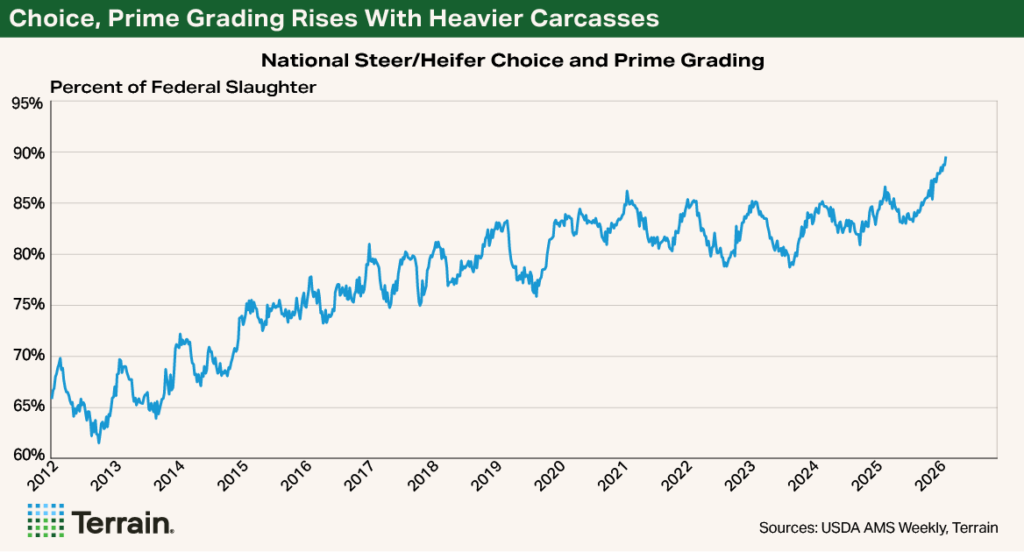
The packers’ slowing of slaughter has resulted in more surplus cattle, most notably in the northern feeding areas. While the increase isn’t particularly burdensome, it is enough to show up in heavier carcass weights (contrary to the seasonal trend) and a higher percentage of Choice and Prime grading carcasses. As a result, bargaining position has shifted to the packers’ favor.
Small Cattle on Feed inventories in the Southern Plains and Colorado appear to have limited the oversupply in these areas, as the live cattle basis continues to strengthen in the Southern Plains.
Consumer Budgets and Retail Beef
News of the strike at the JBS facility in Greeley, Colorado, alongside cooler cleanups in other plants pressured live cattle futures prices and, eventually, 5-Area live cattle prices lower in March. The wholesale boxed beef market experienced a supply shock, getting the spring beef rally started ahead of grilling season.
Feeder cattle futures haven’t fared much worse than live cattle markets on a dollar-per-head basis, but they have declined about $20/cwt (versus $10/cwt for live cattle). As a result, feeder steer values dropped about $150/head. I still project that the average Oklahoma City feeder steer purchased the second week of March will lose more than $300/head.
External factors have begun to lean bearish and add volatility to the marketplace.
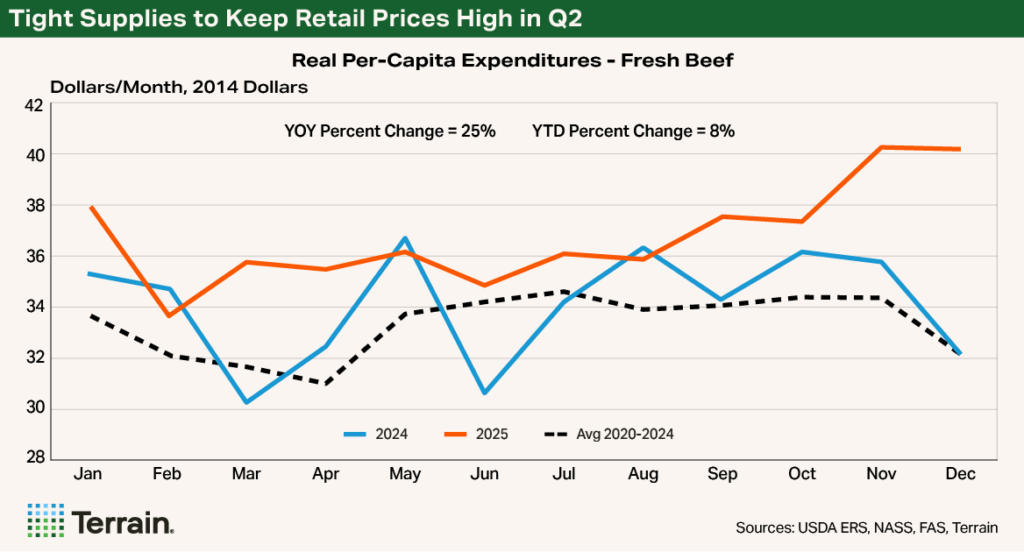
Real per capita beef spending remained record high through 2025. Retail beef prices, both Choice and All-Fresh, were record high in February. Retailers will likely continue to increase prices in the beef case, anticipating continued higher cutout values due to tightening supplies.
While fundamental market factors (tight cattle supplies, lower beef production, and strong consumer spending) remain supportive of cattle prices, external factors have begun to lean bearish and add volatility to the marketplace.
For one, the military action in Iran has a direct effect on consumers’ fuel budgets. Consumer confidence has already taken a hit because of ongoing affordability concerns and declines in investment and retirement accounts. This combination has the potential to limit consumer spending on beef items at grocery stores and restaurants.
I expect cattle slaughter in Q2 2026 to run 4% to 6% below year-earlier levels
Production and Price Expectations
I expect cattle slaughter in Q2 2026 to run 4% to 6% below year-earlier levels and beef production in Q3 2026 to run 2.5% to 5% below 2025 levels. The increase in average fed cattle dressed weights will likely offset 2.5% to 3% of the slaughter decline. In this scenario, continued record-high imports could cause net beef supplies and per capita consumption to increase 0.5% to 2% for the middle two quarters of 2026. Rising retail prices during summer will equate to continued robust beef demand.
I expect fed cattle prices to average $250/cwt to $255/cwt (with a range of $245/cwt to $265/cwt) in Q2 and close to $260/cwt in Q3. This will likely lead to slight profits for cattle marketed during Q2 and similar-size losses in Q3.
Feeder cattle prices will likely trade sideways from $365/cwt though April and then return to rally mode for the rest of Q2 and Q3 — averaging $380/cwt to $385/cwt for Q2 and $410/cwt to $415/cwt for Q3.
I expect Oklahoma City 450-lb. steer calves to be mostly rangebound into the fall, with prices averaging $560/cwt to $580/cwt in Q2 and $580/cwt to $600/cwt in Q3.
These forecasts are mostly unchanged from prior expectations and remain record high on strong beef demand and historically short supplies.
Terrain content is an exclusive offering of AgCountry Farm Credit Services,
American AgCredit, Farm Credit Services of America and Frontier Farm Credit.