





Report Snapshot
Situation
The hog market remains fundamentally sound, with strong margins driven by low feed costs, tight cold storage and strong exports.
Finding
Forward margins over the next 12 months offer profit opportunity, yet disciplined, proactive margin protection is needed amid heavier weights and fund length-induced volatility risk.
Margins continue to run well above seasonal norms.
Pork producer margins continue to hold firm and will likely remain favorable over the next 12 months. While fundamentals remain supportive of strong margins — with low feed costs, tight cold storage and strong exports — proactive margin protection is warranted as trade uncertainty, supply and market sentiment evolve.
Margin Strength Persists
Profitability across the hog sector remains resilient. Iowa State University estimates February farrow-to finish returns at $15.62 per head, extending the industry’s profitability streak to 23 consecutive months. Margins continue to run well above seasonal norms, particularly when viewed against the five-year (-$1.72 per head) and 10-year ($2.06 per head) February averages.
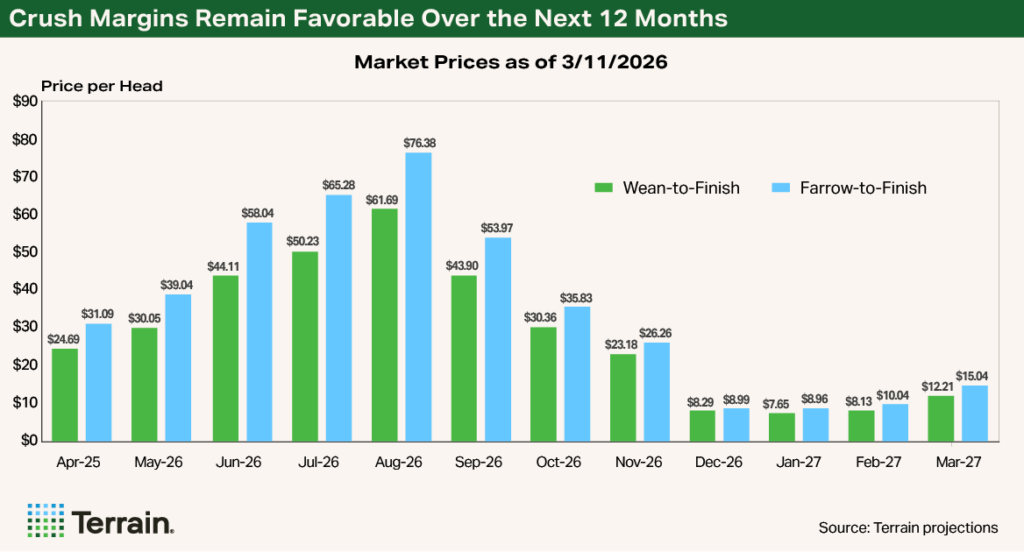
I project farrow-to-finish margins to average over $42 per head in Q2.
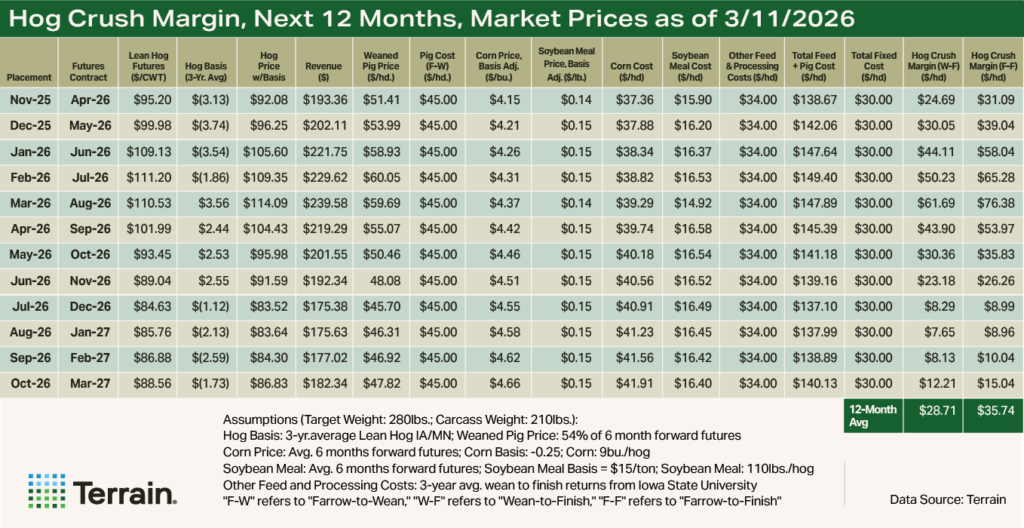
Based on futures pricing as of March 11, margin prospects remain attractive. I project:
- Wean-to finish margins to average better than $32 per head in Q2 2026 and over $28 per head over the next 12 months.
- Farrow-to-finish margins to average over $42 per head in Q2 and exceed $35 per head on a full-year basis.
Disease-related supply constraints are also pushing weaned pig prices higher, with values still running approximately 65% above year-ago levels — a cost that some producers will need to continue monitoring.
Key Margin Supports
Low feed costs, tight cold storage and strong exports are contributing to the sustained favorable margins.
Low Feed Costs
Omaha cash corn prices were mostly rangebound early in 2026 before conflict in the Middle East lifted prices to $4.49/bu., still 18% below the five-year average. While soybean meal has firmed modestly, up 10% this year through March, it remains deeply discounted at $333 per ton, which is 13% below the five-year average. Still, producers should consider the risk of feed costs increasing if the conflict in the Middle East continues.
February 2026 represents the lowest February pork stocks on record dating back to 1997.
Tight Cold Storage
As of the end of February, pork stocks totaled 403.5 million pounds, down 0.1% from January and down 5% from 2025 levels. Even so, inventories remain notably constrained at 14.7% below the five-year average. Additionally, February 2026 represents the lowest February pork stocks on record dating back to 1997.
The ongoing inventory tightness continues to provide underlying support for pork values heading into the summer grilling season and limits downside risk to prices.
Strong Exports
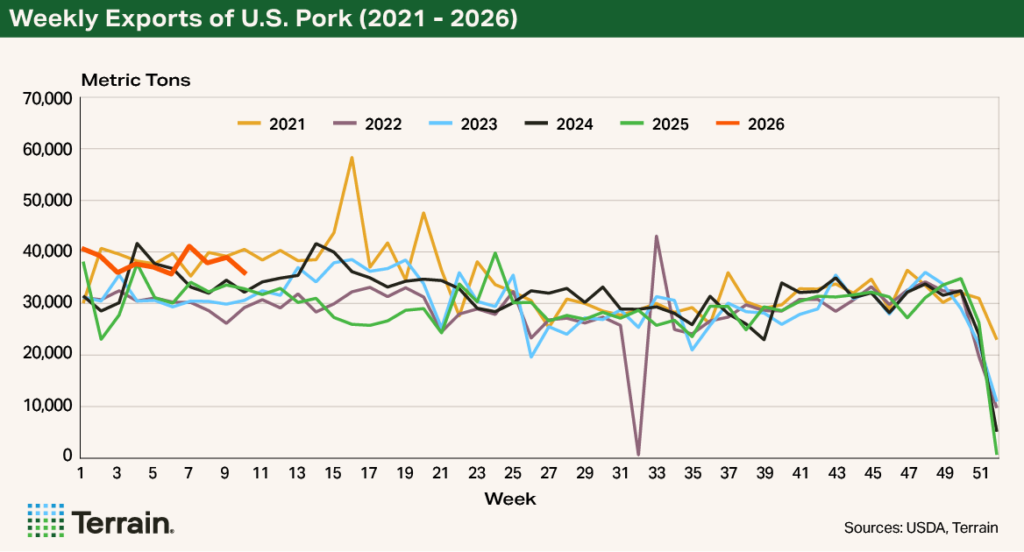
After closing 2025 on a strong note, U.S. pork exports got off to a solid start in 2026. Weekly exports for March 6 to March 12 totaled 35,674 metric tons (MT). Shipments ran 9% above year-ago levels and 8% above the five-year average. Pork net sales totaled 28,284 MT, rebounding 19% from the previous week and up more than 56% year over year (YOY), though they remain about 7% below the five-year average.
In 2025, export value per head slaughtered averaged $65.76, modestly below 2024’s $66.92 but above 2023’s $64.14 — underscoring the durability of export demand despite shifting global dynamics. Export value per head to Mexico has more than doubled since 2020, rising from $8.89 and reaching $22.35 in 2025, solidifying its position as the largest global destination for U.S. pork.
Broader Latin America (excluding Mexico) has emerged as an increasingly important demand base, with export value per head climbing from $8.65 in 2023 to $11.19 in 2025. In contrast, several legacy markets posted declines from 2024 to 2025, including Canada ($6.69 to $5.94), China ($8.63 to $6.72), Japan ($10.71 to $9.68) and South Korea ($5.64 to $5.23).
Notably, gains from Mexico and Latin America offset roughly 78% of the losses across Canada, China, Japan and South Korea, highlighting the growing strategic importance of Western Hemisphere demand.
With the USDA projecting a 3.1% YOY increase in U.S. pork exports in 2026, currency dynamics are also providing meaningful support. A softer dollar helps reinforce U.S. pork’s competitive position in global markets and should continue to support export demand as the year progresses. Tariff and trade uncertainties and a recent uptick of the U.S. dollar against some currencies will remain front and center.
A Layered Approach to Risk Management
Looking further out, fourth-quarter 2026 and first quarter 2027 margins are notably attractive on a historical basis. Given typical seasonal price weakness and expectations for expanding pork supplies during these quarters, these periods may warrant proactive risk management.
Rather than fully covering at current levels, a layered approach to protection could be appropriate, allowing producers to secure attractive margins while retaining upside flexibility should the market extend higher.
Q2 2026 Price Forecasts


Q2 2026 Price Risks
Upside Risks
Animal Health: Disease-related inefficiencies continue to lend structural support to hog prices and forward margins by increasing supply uncertainty and limiting downside price risk. In February, Porcine Reproductive and Respiratory Syndrome positivity registered at 27.8%, above the seasonal five-year average of 26.4%. (It’s weighing on performance rather than driving the kind of acute herd losses seen in prior outbreak years.) Meanwhile, Porcine Epidemic Diarrhea Virus positivity in February reached 14.9%, above the five-year seasonal average of 13.2%, with strength concentrated in wean-to-market and adult/sow operations.
Cold Storage: The pork cutout is positioned to hold strong value in Q2 — and likely through much of the summer months — as domestic demand remains strong and freezer stocks remain tight overall. USDA cold storage data, as of February 28, still point to a pork complex that is tighter than normal in several key cuts (bellies, loins, ribs and butts), even if a few categories have slightly rebuilt versus last year’s tight levels (hams and picnics). That mix can keep the cutout supported and more reactive to short-term shifts in demand, especially as the market transitions from the post-Easter holiday toward the summer grilling season.
Beef Prices: USDA data show retail beef prices averaged 1.91 times retail pork prices recently, compared with closer to 1.6 over the past five years. With retail beef prices still well above historical norms, pork remains competitively positioned as a value alternative in the meat case as wage growth for consumers continues to converge with overall inflation.
Downside Risk
Carcass Weights: Producer owned-barrow and gilt weights are up 0.1% YOY and up 1.6% relative to the five-year average. Packer-sold weights are also elevated, up 2.6% YOY and 1.9% above the five-year average, while packer-owned weights are up 1.1% YOY. While heavier weights add supply to the market and can create price pressure at the margin, strong domestic demand and solid export performance remain critical offsets.
Considerations for Q2 2026
1. Lock In Margins, Not Just Prices
As I discussed in my Q1 2026 outlook, hog futures remain seasonally strong, and feed costs remain lower. As a result, forward-looking margins continue to appear favorable out to 2027. Disciplined margin management remains critical to ensure you are protecting profits.
Focus on deferred contracts and collaborate with marketing advisers and Farm Credit insurance specialists to secure profits as far forward as market conditions and risk management policies allow.
2. Fund Positioning Adds Layer of Risk
Producers should keep an eye on speculative and managed money positioning. Commitment of Traders data show managed money holding a sizable net long position in lean hog futures as of March 17, underscoring how heavily funds have participated in the recent rally.
Historically, environments like the current one have rewarded incremental hedging or margin protection.
While strong fund participation can help extend rallies, elevated speculative length also increases the market’s sensitivity to shifts in sentiment. Periods of heavy net long-positioning can leave prices vulnerable to bouts of long liquidation if catalysts emerge.
Historically, environments like the current one have rewarded incremental hedging or margin protection, particularly when favorable pricing opportunities — such as those seen into Q2 — are available.
Terrain content is an exclusive offering of AgCountry Farm Credit Services,
American AgCredit, Farm Credit Services of America and Frontier Farm Credit.