



Outlook • May 1, 2026
Fiber of Optimism for Cotton

Report Snapshot
Situation
Despite sharp swings in fertilizer and fuel costs, the projected operating margin for cotton has improved modestly since the start of the Iran war.
Outlook
Near-term margins will be sensitive to energy and fertilizer headlines, but the market appears motivated to “buy acres” for cotton.
Impact
Given the mix of market risks, producers may benefit from pairing downside protection with flexibility to participate in any further upside price action.
Fuel and fertilizer prices have risen significantly due to the disruption of the Strait of Hormuz as the Iran war continues. On April 9, our senior grain and oilseed analyst, Marc Rosenbohm, joined The Cotton Companion Podcast to discuss how these shifting input costs have influenced projected cotton producer margins.
You can listen to the full podcast episode in the audio player at the top of this page.
The following is a recap of the interview.
Why the Strait of Hormuz Is So Important
Between 13% and 38% of global trade in crude oil, fuel, fertilizers and chemicals transits this narrow waterway, according to the U.N. It serves not just Iran but other important energy-exporting countries as well, including Qatar, Saudi Arabia, Iraq, Kuwait and the UAE.
Demand is mostly inelastic for these products, so when there are disruptions such as the closure of the Strait, prices rise significantly and ration consumption in the short run.
This contributes to the high volatility in those input prices.
Operating Margin Movement Since the War
As fuel and fertilizer costs have risen over the past month and a half, cotton prices have also moved higher — to around 73 cents on the nearby May contract and almost 77 cents on the December contract as of April 9, and even higher more recently.
A few factors are behind this upward price movement:
- Managed money was net short over 74,000 contracts in the report following the start of the Iran war. In subsequent weeks, those shorts were steadily covered to bring them to almost even by April 9. Managed money is now over 13,000 contracts net long as of the most recent report on April 14.
- Higher petroleum and petroleum product prices increased the anticipated production costs and prices for synthetic fibers, increasing demand for cotton where blends could be shifted.
- Concerns about future production. At higher production cost levels, prior cotton prices could have led to a further expected reduction in cotton area and supplies in the U.S. and other cotton producers such as Brazil and Australia.
For the crop being planted now, projected operating margins have experienced a lot of volatility since the Iran war began. Still, the net combination of higher input costs and higher cotton prices has left the U.S. average operating margin projection slightly better than prior to the start of the war. The indicator was at about $100 pre-war, whereas it was about $125 on April 9 and is currently about $150 (as of April 22).
Margins for any of the major cotton-growing regions in the U.S. will look slightly different than for the U.S. average, but the overall trend remains the same at the regional level. While many factors can influence projected and actual operating margins, current projections indicate that cotton is likely in at least a slightly better situation than it was prior to the war.
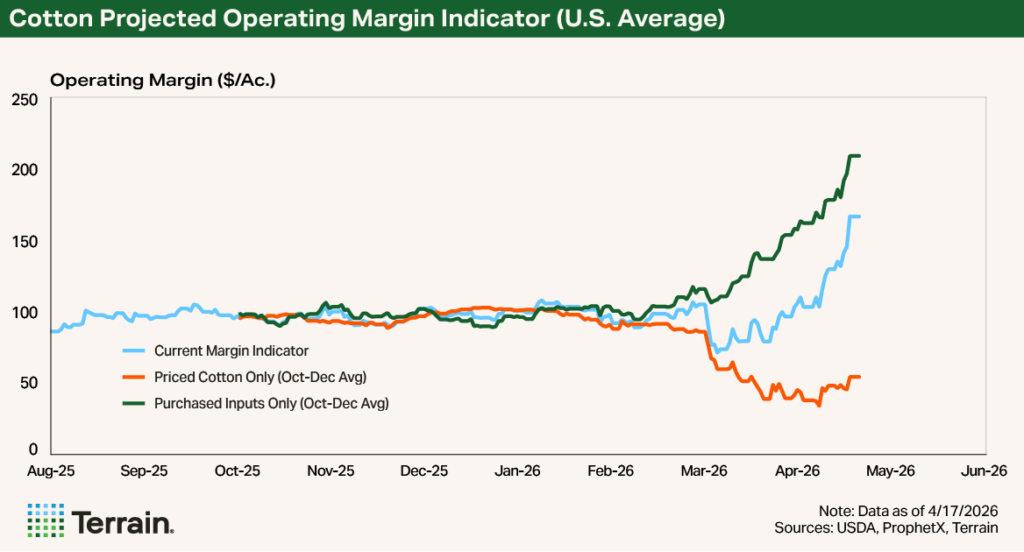
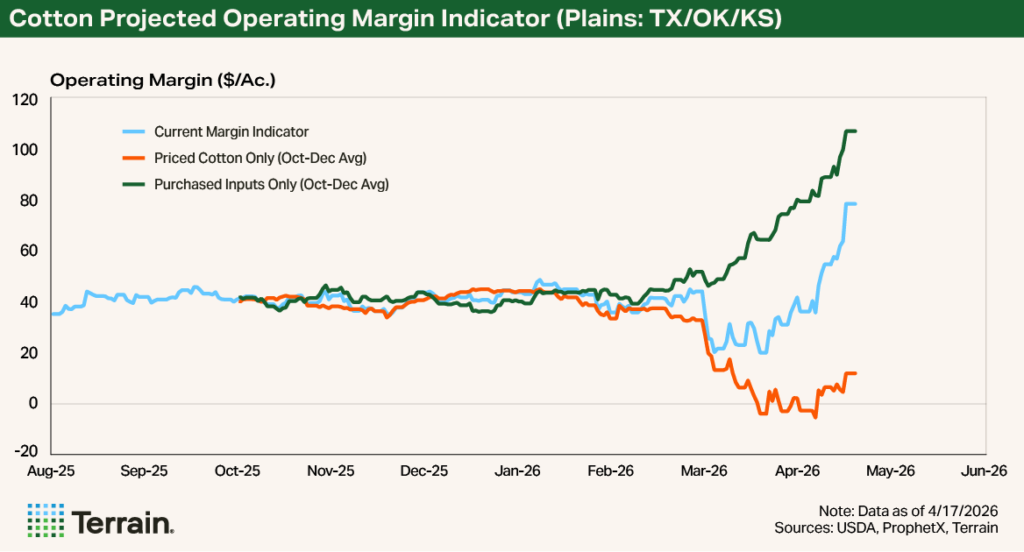
In a best-case potential scenario where a farmer purchased inputs in the October-December window, they may be currently seeing about a $70/ac. gain in margin.
Even in a situation where minimal inputs were secured (seed only, for example), the net effect of the fertilizer and fuel price changes and cotton price changes since the war started could be an improvement of $40/ac. now. (Though they went through a period immediately after the war began where they were $20/ac. lower.)
At the other extreme is a farm that may have sold their expected production on average between October and December for the year ahead. Their margins could be $30-$40/ac. lower than before the war, showing the significant hit fertilizers and fuel can have on margins if they were not able to capture the upside of prices, too.
Cotton’s price changes from pre-war levels exceed those of corn, soybeans and wheat.
For many producers, I expect the reality to be somewhere near the middle scenario.
The War’s Influence on Planted Acreage
Cotton’s price changes from pre-war levels exceed those of corn, soybeans and wheat. Current projected average operating margins for these other crops are similar to or only slightly above their pre-war levels.
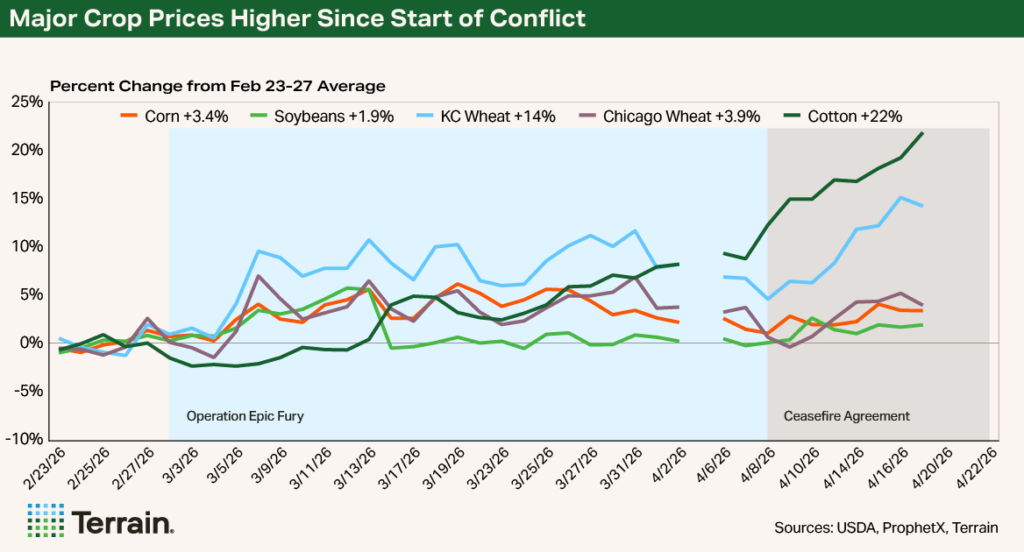
Currently, the market appears to be attempting to “buy acres” of most crops except corn as price moves for those crops incentivize small acre shifts at the margin. This includes soybeans most notably, but also a bit of spring wheat and cotton. These margins and other factors will influence final cotton acres, but we will have to wait until June for the USDA’s next estimates of 2026 cotton acres.
Near-Term Risks for Cotton Prices
It’s important for cotton producers to take a holistic view by considering both input costs and expected prices. High input costs by themselves are not necessarily bad if crop prices more broadly or U.S. cotton prices more specifically are at sufficient levels.
Potential near-term upside and downside risks to the 2026 cotton price outlook include:
Upside:
- Major fertilizer or energy issues further tighten expected supplies for the next year or two. This could involve a scenario where the ceasefire falls apart or the war resumes and/or escalates.
- The effects of energy and biofuel markets impact other crop markets and ultimately spill over to influence cotton prices via the potential for subsequent acreage shifts.
Downside:
- Sustained higher energy prices weigh on consumers' textile spending.
- Sustained disruption of energy flows potentially weighs on global GDP growth, consumer incomes, or other macroeconomic factors that affect demand for textiles.
For farmers, protecting downside while leaving some or all upside open may be worth considering for risk management when balancing where prices and margins are now with the uncertainties ahead.


Terrain content is an exclusive offering of AgCountry Farm Credit Services,
American AgCredit, Farm Credit Services of America and Frontier Farm Credit.