



Outlook • April 9, 2026
Component Shifts to Shake Up Dairy Markets in 2026
Article Originally Published in the April 2026 Issue of Progressive Dairy




Report Snapshot
Situation
A mismatch in the supply and demand of individual commodities is sparking volatility that could provide a lift to some milk prices and opportunities to hedge going forward.
Outlook
If cheese and butter prices continue to improve, it would provide even greater support to milk prices later in 2026. But, for now, it’s the powders that have provided the strength.
Finding
The dynamics this year will be driven more by adjusting to component demand shifts than by growing supply.
After a surplus of milk in global markets pulled down milk prices at the end of 2025 and into the beginning of 2026, prices rebounded sooner than expected. That surplus isn’t fully alleviated, but a mismatch in the supply and demand of individual commodities is sparking volatility that could provide a lift to some milk prices and opportunities to hedge going forward.
Cheese and butter typically drive milk’s value in the U.S. These higher-value consumer products drive the prices of Class III and Class IV milk by determining the values of protein and fat. The byproduct of cheese manufacturing is whey, and the byproduct of butter manufacturing is nonfat dry milk. These powders have headed for export markets historically.
As a result, most of the high-value milk fat has remained in the U.S. where it can capture its highest value in the form of butter and cheese, while exports have been heavily skewed toward skim solids.
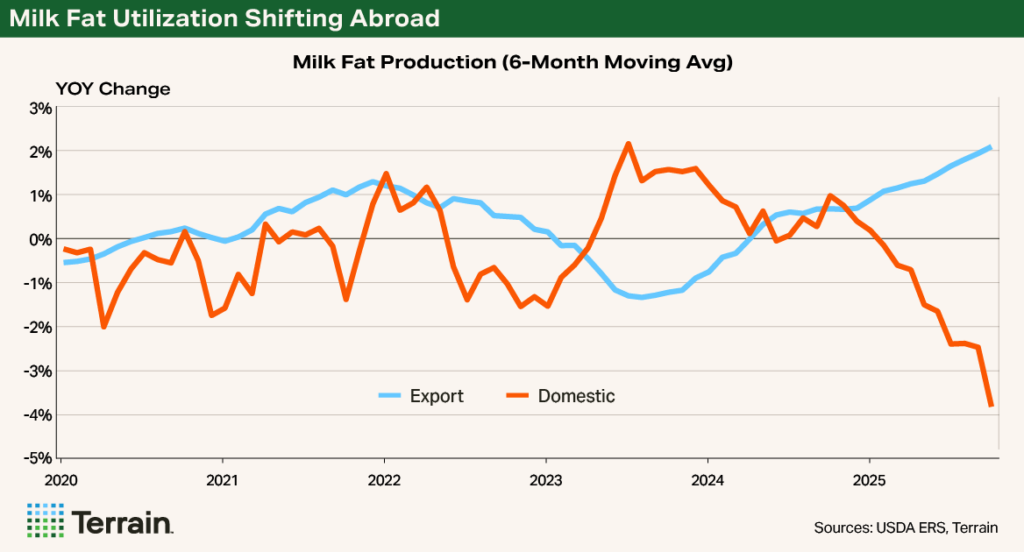
Through late summer and fall 2025, commodity prices for butter and cheese collapsed. Whey was the only exception, with growing demand for high-protein powders reducing the supply of sweet dry whey. Nonfat dry milk had been lackluster throughout the turbulence, but through January and early February, prices for the commodity skyrocketed.
Consumers are undergoing a variety of shifts domestically and abroad that are shaking up those traditional component mixes. These shifts have been playing out over different timelines, but they are converging in the current market. The byproducts are now stealing the show.
Near- to Long-Term Demand Shifts
First, there is a near-term (though I expect persistent) shift in consumer demand for protein versus fat due to growing adoption of GLP-1 medications. Estimates point to around 8% of Americans taking GLP-1s as of 2024. That’s likely higher by this point and will increase as new pill forms and other varieties are developed. Importantly, the impact isn’t isolated to those taking the drugs. Some 16% of households include at least one person using GLP-1s, and food purchasing patterns will likely change for the entire household. New products being developed and marketed will likely appeal to a broader set of consumers than just GLP-1 users.
In the medium term, pressures are driving changes at the macroeconomic level. Inflation for food away from home has been persistently higher than food prepared at home since March 2023, meaning that eating out has become more expensive, more quickly than staying in. This matters for dairy demand because Americans tend to eat more cheese-heavy dairy away from home (think pizza and cheeseburgers) than when they prepare their own food. Food service is also an important outlet for butter and cream.
Long term, aging populations both domestically and in many of our key dairy export destinations will influence demand. In “The Big Shrink” research series, Terrain analysts detail the impact of aging populations on agriculture. For dairy, aging populations are a mixed bag.
In the U.S., younger people in their key pizza-consuming years have been shrinking as a share of the total population while those over 60, who are not eating nearly as much pizza, have become the fastest-growing segment.
Meanwhile, alongside the aging populations abroad, incomes are rising among populations in many of our export destinations and demand for higher-value (and higher-fat) dairy products like cheese and butter are climbing.
The net result of these shifts is that a bigger share of U.S. milk fat production is looking to export markets for value, while skim solids are trying to sort out ways to capitalize on strong protein demand at home.
This means cheese and butter are increasingly reliant on export sales. This is fine, except when world prices are low, U.S. prices need to fall to remain competitive. In the case of nonfat dry milk, not only have world prices improved (giving domestic prices a boost), but supplies were already relatively tight with the stream of skim solids looking for ways to deliver protein elsewhere in the value chain.
Byproducts Carry the Day
Nonfat dry milk prices climbed from $1.18/lb. at the beginning of 2026 to over $1.60/lb. by early February. This has dramatically lifted Class IV milk out of the doldrums, with futures prices over $18 per hundredweight (cwt) from March onward, versus a January price of $13.55/cwt, as of this writing.
Class III milk has improved less dramatically but is supported largely by whey prices of between 70 cents/lb. and 75 cents/lb.
Cheese and butter prices have improved from their lows, but to a lesser degree. If they continue to improve, it would provide even greater support to prices later in 2026. But, for now, it’s the powders that have provided the strength.
I expect the worst of the market weakness from the start of the year has passed, but the spring flush will be a test. It could be a year of volatility. The dynamics this year will be driven more by adjusting to component demand shifts than by growing supply. The volatility should provide opportunity to lock in manageable margins given the expected continued low feed costs and beef revenue streams from cull and cross-calf sales.

Terrain content is an exclusive offering of AgCountry Farm Credit Services,
American AgCredit, Farm Credit Services of America and Frontier Farm Credit.