



Outlook • March 2, 2026
California’s Shifting Fuel Rules Pose Hurdle for Grain Producers
Low Carbon Fuel Standard Update: Midwest Edition




Report Snapshot
Situation
Recent changes to California’s Low Carbon Fuel Standard could threaten the renewable diesel feedstock market. Under a tighter carbon-intensity schedule, renewable diesel will generate fewer credits, and crop-based renewable diesel will eventually face a 20% cap on credit generation.
Impact
Soybean oil's upside potential as a preferred biofuel feedstock will be limited. Farmers should follow federal and state biofuel policy changes, which directly influence soybean oil's biofuel market share, the domestic crush pace and, ultimately, basis.
Renewable Diesel Disruption
California’s Low Carbon Fuel Standard (LCFS) has been successful in changing the state’s fuel landscape. As an emissions trading scheme for transportation fuels, LCFS rates each fuel against a carbon-intensity target based on lifecycle emissions per unit of energy. Cleaner fuels earn credits; dirtier fuels rack up deficits.
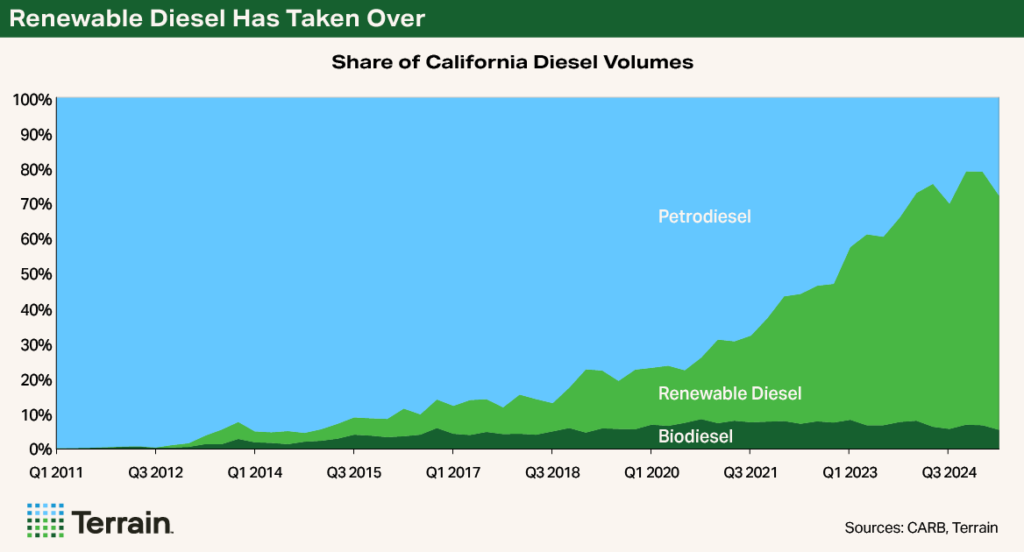
Since its implementation in 2011, the program has outperformed, meaning more credits have been generated relative to demand, pushing down the credit price. A high number of credits to date have been generated by biofuels and specifically renewable diesel, which now makes up nearly 70% of diesel volumes.
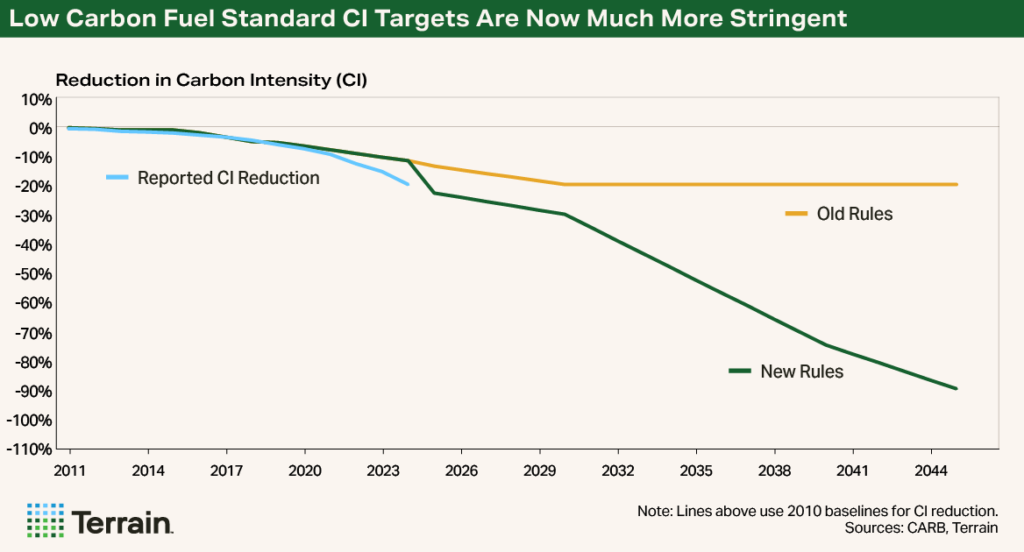
However, in response to criticism by environmentalists that the program has been too lenient, the California Air Resources Board (CARB) adopted major changes to LCFS in July 2025. These changes raise important questions about how California’s fuel environment will evolve, and the subsequent disruption to renewable diesel refiners and the oilseed crush plants who supply their feedstocks.
Three changes are particularly significant:
- Stricter Carbon-Intensity Reduction Goals: The carbon-intensity reduction target is now 90% by 2045, with an auto-acceleration mechanism that makes the targets stricter if there’s an oversupply of credits. This is up from the previous goal of 20% by 2030.
- Adoption of CA-GREET 4.0: Starting July 1, 2025, new applications must use the CA-GREET 4.0 model; all fuel producers must comply by January 1, 2027. This means higher carbon-intensity scores and fewer credits for fuels made from soybean, canola and sunflower oils.
- Limits on Crop-Based Renewable Diesel: CARB has set a 20% cap on crop-based biofuels in annual diesel reporting, effective January 1, 2028, with current pathways exempt until then.
Reforms Will Affect Crushers to Growers
Predicting the state’s fuel markets, however, requires caution. LCFS reforms are only one of several forces reshaping California’s energy landscape, and many of these pressures move in conflicting directions. Refinery closures, the potential expansion of E15, the rise of electric vehicles, volatility in credit markets, and broader economic conditions all interact with LCFS in ways that are difficult to model precisely.
Even so, the implication for Midwest agriculture is increasingly clear.
Renewable diesel refiners and the oilseed crush plants who supply their feedstocks are likely to experience significant disruption, as renewable diesel generates fewer credits under the tighter carbon-intensity schedule.
While the most immediate effects will be softened by the temporary grandfathering of existing pathways through 2027, the structural shift becomes unavoidable in 2028, when crop-based renewable diesel faces the 20% cap on credit generation.
This shift is likely to be felt from crushers all the way down to growers. In recent years, soybean oil has played an important role in soybean economics. During parts of 2021 and 2022, oil accounted for roughly half of a bushel’s value, compared with a historical average closer to one-third, according to a 2025 University of Illinois paper. However, the 20% cap will undoubtedly temper U.S. soybean oil demand, highlighting the influence CARB has on U.S. agriculture.
The surge in biofuel production from 2021 to 2025 relied on steady demand from California, but further growth now requires caution.
Preparing for a Long and Winding Road
Given these changes, producers in the Midwest must plan carefully for the future.
Renewable diesel producers, who expanded quickly in response to market signals, now face uncertainty due to LCFS amendments. The surge in biofuel production from 2021 to 2025 relied on steady demand from California, but further growth now requires caution. Producers should reassess their strategies as crop-based renewable diesel faces increasing constraints within California’s compliance system.
While much about California’s fuel future is unpredictable, the agricultural industry can take proactive steps to navigate the evolving environment.
While farmers can't control California regulations, they can stay aware of evolving state and federal biofuel policies and the influence on local crush plants' demand for soybeans. Also, by working with local crush plants, farmers can be better prepared for how soybean oil demand will be shaped as other states continue to adopt their own versions of low-carbon programs.
While much about California’s fuel future is unpredictable, the agricultural industry can take proactive steps to navigate the evolving environment. Thoughtful planning, careful investment decisions, and strategic market positioning will be essential tools for farmers and renewable fuel producers alike as the LCFS landscape continues to shift.
(Read “Lower-Carbon Rules, Higher Fuel Prices for California Producers” to learn about the impact of the recent LCFS changes on California's agricultural producers.)
Terrain content is an exclusive offering of AgCountry Farm Credit Services,
American AgCredit, Farm Credit Services of America and Frontier Farm Credit.